
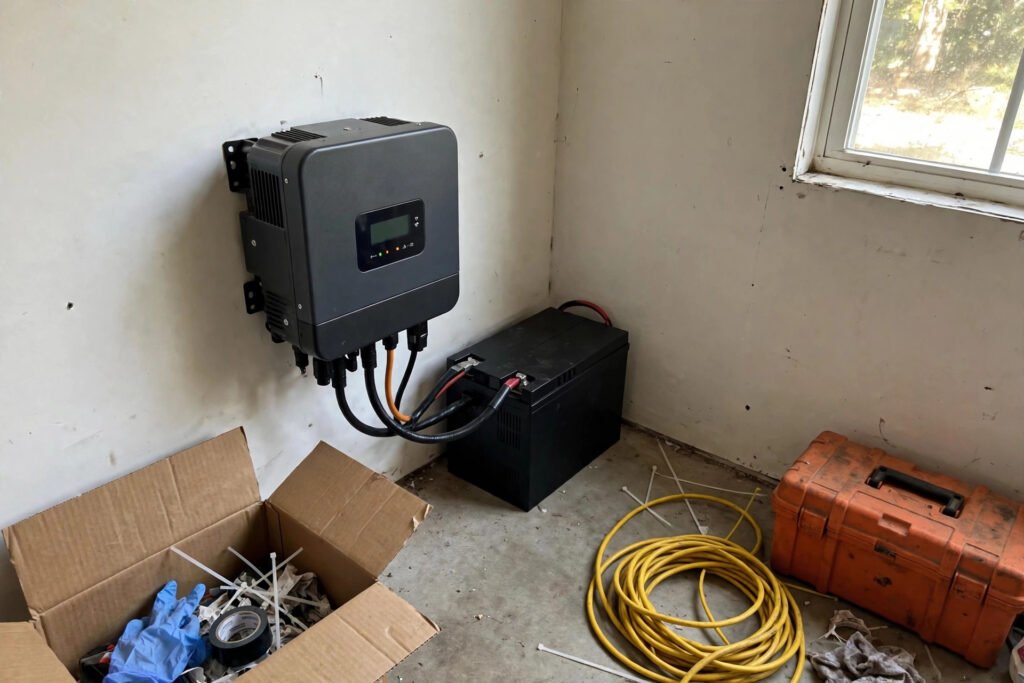
What this guide works from. One rig: a Growatt SPF 5000 ES in USE mode, a DIY 16S pack of 280 Ah EVE cells with a JK BMS (JK-PB2A16S20P), and 6 kW of solar. The pack is 51.2 V rated and holds 14.336 kWh. The house ran flooded lead-acid on this inverter for a year. Absorption is 55.2 V, float is 53.6 V.
The short answer. Yes. Turn equalization off. It is a lead-acid routine: a timed overcharge that stirs the acid in a flooded battery. A LiFePO4 pack has no acid to stir, and the overcharge pushes the pack toward 58.4 V. That is 3.65 V per cell on a 16S pack, the exact point where the BMS cuts the charge. On our rig the BMS tripped every 30 days, always at midday, always on a full pack. One setting fixed it: Growatt Program 43, from Enable to Disable.
The rig that tripped every 30 days
The house runs on solar and a home-built pack: sixteen 280 Ah cells in a steel case, guarded by a JK BMS. The inverter is a Growatt SPF 5000 ES in USE mode: open loop, charging by volts only.
For the first year the same inverter ran four flooded lead-acid batteries. The installer set the charge profile for flooded cells, including equalization: Program 43 Enable, Program 44 at 58.4 V, Program 45 for 60 minutes, Program 47 every 30 days. That was right for lead-acid. Then the owner swapped in the lithium pack. He set Programs 19, 20 and 21 to 55.2 V, 53.6 V, and 48.0 V. He never looked at Programs 43 to 48. They still held the lead-acid numbers.
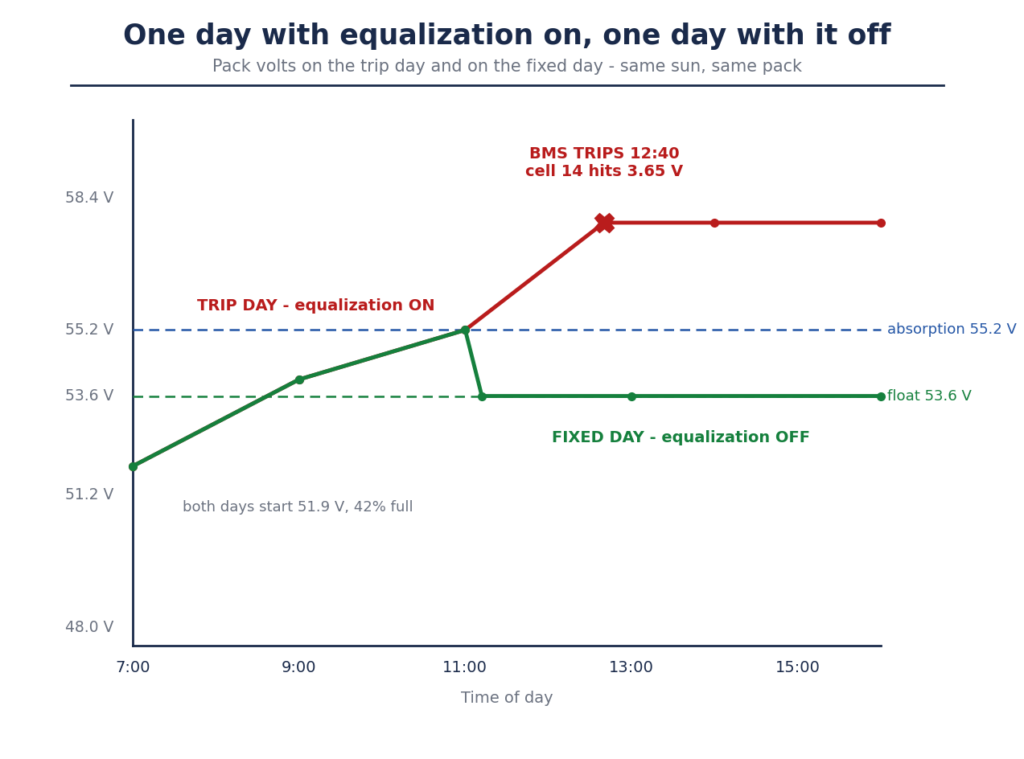
For weeks, nothing looked wrong. Then, on 28 September, the charge stopped dead at midday. The pack read 57.8 V. The charge current had fallen to zero. The BMS app showed over-voltage protection, and cell 14 sat at 3.65 V while the other cells read 3.60 V to 3.62 V. The gauge stuck at 99%.
Thirty days later, on 28 October, it happened again. Same time, same cell, same numbers. Then a third time, on 27 November. Three trips, each 30 days after the last. That rhythm was the clue. Nothing in a lithium pack runs on a 30-day clock. But equalization does: Program 47 ships at 30 days.
Program 43 read Enable. Program 44 read 58.4 V. Program 45 read 60 minutes. The inverter had been running a lead-acid equalization cycle on a lithium pack once a month, and the BMS had been saving the pack each time. He set Program 43 to Disable and Program 48 to Off. The next sunny day the pack filled to 100%.
What equalization is, and what it is for
Equalization is a controlled overcharge for flooded lead-acid batteries. The word sounds like balancing. But it is not the same job as a BMS balance. In a flooded battery the acid can settle. Strong acid sinks to the bottom. Weak acid floats at the top. The manual calls this stratification. The plates can also grow a crust of lead sulfate. One cycle pushes the volts high for an hour or so. The high volts stir the acid by making gas bubbles. The extra charge knocks sulfate off the plates.
LiFePO4 cells have no liquid acid to stir. They have no sulfate crust to knock off. They hold their charge in a solid crystal, not in acid. So the whole reason for this charge does not apply. The high volts only push the cells toward the top of their curve. Up there, a little extra charge moves the volts a lot.
That is the key difference. This charge is a charger routine for one chemistry. Cell balancing is a BMS job for another chemistry. The BMS balances by bleeding a little charge off the high cells at absorption, 3.45 V per cell. Turning it off does not turn off balancing. The BMS keeps balancing.
Victron says it plainly in its solar charger manual: “Do not equalize charge Gel, AGM, VRLA or lithium batteries.” Its lithium preset ships with this charge disabled. The EG4 manual says the same. When lithium batteries run in lead-acid mode, set the EQ voltage, period, and time all to zero.
The maths: what each equalization volt means per cell
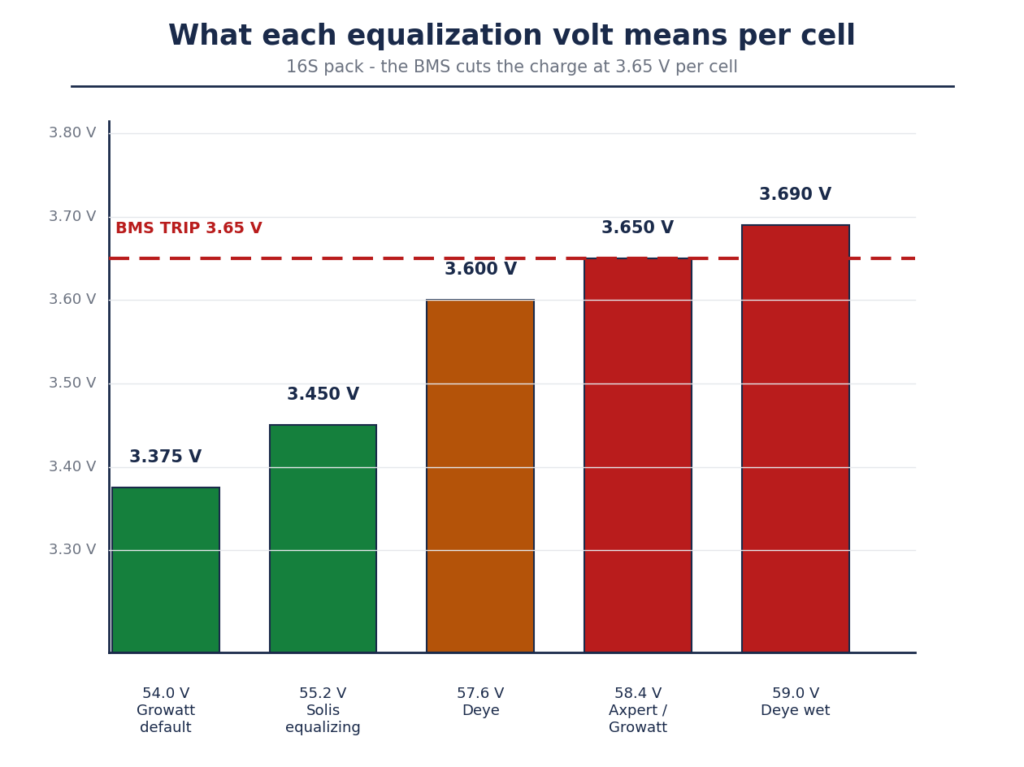
A 16S pack is 16 cells in a row. Pack volts are just per-cell volts times 16. The JK BMS cuts the charge when any one cell hits 3.65 V. That is the hard ceiling.
| Equalization volt | Per cell, 16S | Per cell, 15S | What happens |
|---|---|---|---|
| 54.0 V, Growatt default | 3.375 V | 3.60 V | 16S: below the trip, but pointless. 15S: near the trip. |
| 55.2 V, Solis equalizing | 3.45 V | 3.68 V | 16S: equals absorption. 15S: past the trip. |
| 57.6 V, Deye | 3.60 V | 3.84 V | 16S: 0.05 V under the trip. One fast cell trips. |
| 58.4 V, Axpert and Growatt flooded | 3.65 V | 3.89 V | 16S: exactly the trip point. Any spread trips. |
| 59.0 V, Deye wet | 3.69 V | 3.93 V | Past the trip on any pack. |
Read the 58.4 V row twice. 58.4 V divided by 16 is exactly 3.65 V, so the inverter aims at the BMS trip point itself. Cells never match perfectly. One cell always runs a little ahead. On our rig cell 14 ran about 0.05 V ahead, so it hit 3.65 V while the pack read only 57.8 V. The inverter never reached its target. The BMS cut the charge first.
The Deye row is the quiet version of the same trap. 57.6 V is 3.60 V per cell, only 0.05 V under the trip. The Solis row is the safe one: 55.2 V is 3.45 V per cell, the same as absorption. But that only holds if nobody raised it.
The same maths warns you about a 15S pack. At 58.4 V it is 3.89 V per cell. A Pylontech pack is 15S, and its manual caps charge volts at 53.5 V. Full 15S and 16S settings are in the open-loop voltage settings guide.
What the makers actually print
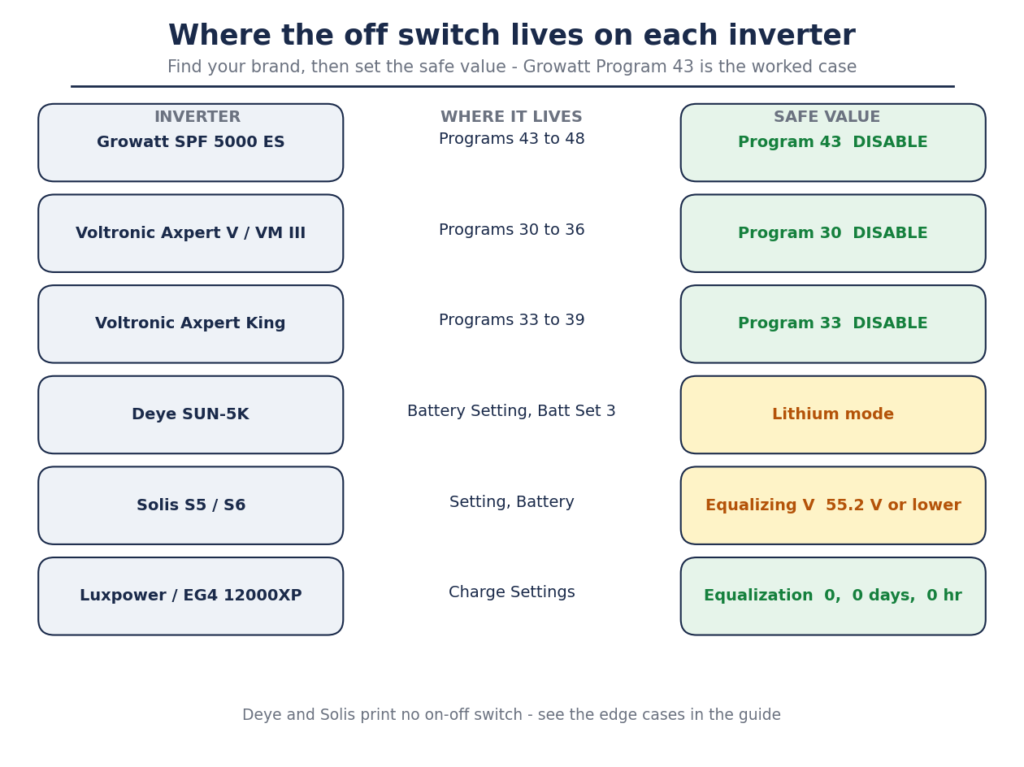
Every maker hides this setting in a different place.
| Inverter | Where the setting lives | Safe value for LiFePO4 | Equalization volt if left on |
|---|---|---|---|
| Growatt SPF 5000 ES | Programs 43 to 48 | Program 43 Disable, Program 48 Off | 54.0 V default; 58.4 V on our rig |
| Voltronic Axpert V / VM III | Programs 30 to 36 | Program 30 Disable | 58.4 V default on the 5 kVA model |
| Voltronic Axpert King | Programs 33 to 39 | Program 33 Disable | 58.4 V default |
| Deye SUN-5K | Battery Setting, Batt Set 3 | No off switch printed; use Lithium mode | 57.6 V, 3.0 hr, every 30 days |
| Solis S5 / S6 | Setting, Battery, Equalizing Charge Voltage | No on-off switch found; 55.2 V or lower | 55.2 V in the Solis lithium guide |
| Luxpower / EG4 12000XP | Charge Settings | Equalization Voltage 0, Period 0, Time 0 | 50 to 59 V range for lead-acid |
Growatt puts equalization in Programs 43 to 48, and only when Program 05 is Flooded or User-Defined. In USE mode, the setting is live. Program 43 is the on-off switch. Program 44 is the volt. Program 45 holds it for 60 minutes. Program 46 is the timeout, 120 minutes. Program 47 is the interval, 30 days. Program 48 starts one right now. The manual page prints no default for Program 43 or 44.
Axpert has two numberings, and this is a real conflict in the docs. The Axpert V manual and the VM III guides use Programs 30 to 36. Program 30 is the switch. It ships disabled. Program 31 is the volt at 58.4 V. Programs 33 to 36 set time, timeout, interval, and start-now. The Axpert King manual uses Programs 33 to 39 for the same settings. Same job, different numbers.
Deye is the awkward one. Its Battery Setting page, Batt Set 3, shows Equalization V at 57.6 V, Equalization Days at 30 days, and Equalization Hours at 3.0. The manual page prints no on-off switch. In Lithium mode the BMS sets the volts, so equalization should not run. In Use Batt V mode the fields are live.
Solis shows an Equalizing Charge Voltage field in Setting, then Battery. Its own guide for a 51.2 V lithium pack in open loop sets that field to 55.2 V. No on-off switch was found in the sources read for this guide. At 55.2 V the field is harmless. The risk is an installer who raised it.
Luxpower is the clearest of all. The EG4 12000XP manual, written by Luxpower, says it in plain words. When lithium batteries run in lead-acid mode, set Equalization Voltage to 0, Equalization Period to 0 days, and Equalization Time to 0 hours. Three zeros.
Why it trips the BMS
The chain has four links, and each one is simple on its own.
First, the timer. Equalization runs on a clock, not on need. Program 47 says 30 days, and on day 30 the inverter starts a cycle whether the pack needs it or not. That is why the trip lands at midday.
Second, the volt climb. The inverter leaves float, passes absorption, and keeps climbing toward the equalization volt. On our rig that meant climbing from 53.6 V, past 55.2 V, toward 58.4 V. The pack was already full.
Third, the knee. LiFePO4 has a flat volt curve for most of its range, then a sharp bend near the top, called the knee. On the flat part, a lot of charge moves the volts a little. On the knee, a little charge moves the volts a lot. At 3.60 V per cell the pack is already on the knee. So the fastest cell ran away from the rest. Cell 14 hit 3.65 V while the pack still read 57.8 V. The inverter only sees pack volts.
Fourth, the cut. The JK BMS watches each cell, and its over-voltage trip is 3.65 V per cell. When cell 14 hit that line, the BMS opened its charge switch. The charge current fell to zero in a second. The BMS did exactly what it is built to do. It is a safety switch, not a charge controller.
One trip does not mean the pack is damaged. The BMS cut the charge before any cell went past 3.65 V. The fix is not a better BMS. The fix is to stop asking the inverter to overcharge a pack that never needed it.
Set it in order: ten steps, each with a check
Work the steps in order. If a check fails, stop there. These steps are for a Growatt SPF 5000 ES. On an Axpert use Program 30 instead of Program 43. On a Deye use Lithium mode. On a Luxpower set the three equalization fields to zero.
- Write down the dates of the last two trips. Look in the BMS app history or your own notes. Count the days between them. Check: the gap is 28 to 32 days. On our rig it was 30 days, twice.
- Read all 16 cell volts in the BMS app at rest. Do this in the morning, with no charge and no load. Write down the highest cell, the lowest cell, and the spread. Check: spread 0.10 V or less, and no cell above 3.45 V.
- Read the BMS protection log. Find the over-voltage trip and note the cell and the volt. Check: the log names the same cell each time. On our rig it was cell 14 at 3.65 V.
- Enter setting mode on the inverter. Hold ENTER for three seconds. Check: the screen shows Program 01.
- Step to Program 43 and read it. Use the UP and DOWN buttons. Do not change anything yet. Check: you know whether it reads Enable or Disable. On our rig it read Enable.
- Step through Programs 44 to 47 and write down each value. 44 is the volt, 45 the time, 46 the timeout, 47 the interval. Check: you have all four numbers written down. On our rig they read 58.4 V, 60 min, 120 min, 30 days.
- Set Program 43 to Disable. Press ENTER, step to Disable, press ENTER again to save. Check: step back to Program 43 and it reads Disable.
- Set Program 48 to Off. This cancels any equalization that is queued to start now. Check: Program 48 reads Off, and the equalization mark is gone from the main screen.
- Check Programs 19, 20 and 21. They should read 55.2 V, 53.6 V, and 48.0 V. Set temperature compensation to zero. Check: all three read right, and temp comp is 0.
- Watch one full sunny day, then write the next date on a card. The pack should fill to 55.2 V, hold, and drop to 53.6 V float with no cut. Work out the next 30-day mark and write it on the card. Check: pack never climbs past 55.2 V, float holds 53.6 V, cells sit within 0.05 V, and the card is written.
Read the meter: what the numbers mean
A meter settles most fights about a charge setting. The inverter screen can lag. On our rig the trip day and the fixed day started the same way: 51.9 V, 42% full, sun up at 7 a.m., 60 A of charge. The only change was Program 43.
| Reading | Trip day, equalization on | Fixed day, equalization off |
|---|---|---|
| Pack volts at 11:00 | 55.2 V, absorption | 55.2 V, absorption |
| Pack volts at 12:40 | 57.8 V and still climbing | 53.6 V, float |
| Highest cell at 12:40 | 3.65 V. Cell 14. | 3.36 V. |
| Cell spread at 12:40 | 0.05 V | 0.02 V |
| Charge current at 12:40 | 0 A. BMS had opened. | 0.8 A, float trickle |
| Gauge at end of day | 99%, stuck | 100% |
| Energy in that day | About 7.6 kWh. Cut came first. | About 8.3 kWh. |
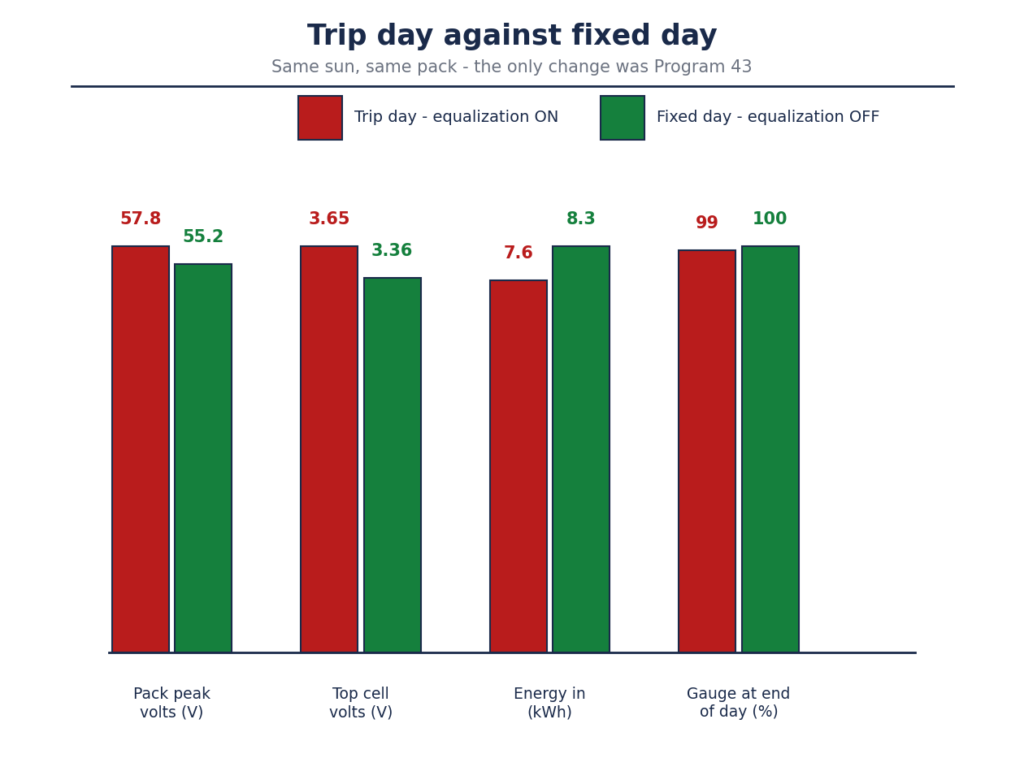
The trip day looks fine until 12:40. But the gauge tells the truth: it stuck at 99% because the charge stopped before the pack finished. The fixed day took in 0.7 kWh more, and the gauge read a true 100%. The SmartShunt guide shows how to count amp-hours for a true reading.
If your numbers do not match this table, the table below says what to check next.
| Reading | What it means | What to do |
|---|---|---|
| Program 43 already reads Disable | Equalization is off, so the trip came from something else | Check absorption, Program 19, and the BMS trip log |
| Pack still climbs past 55.2 V after the fix | A second charger is equalizing on its own | Check the solar charge controller and any second inverter |
| BMS stays open the next morning | The high cell has not fallen back yet | Let the house loads pull the pack down; do not force a reset |
| Cell spread above 0.10 V at rest | The pack is out of balance | Drop absorption to 54.4 V for a week, then set 55.2 V again |
The JK BMS spec gives over-voltage protection at 3.65 V per cell and recovery at 3.40 V per cell. The charge switch stays open until the high cell falls back to 3.40 V. On our rig that happened overnight. Do not force the BMS closed while equalization volts are still applied.
What can still go wrong
The Growatt default is disputed.
Two sources disagree on what Program 43 ships as. SolarNevs reads the Growatt manual and says equalization ships disabled by default. An AI-made summary says it ships enabled. The manual page itself, as read on manua.ls, prints no default for Program 43 or 44. Read Program 43 on your own unit.
Axpert program numbers move between models.
The Axpert V manual puts equalization in Programs 30 to 36. The Axpert King manual puts the same settings in Programs 33 to 39. If Program 30 on your unit holds something else, you are on the King numbering. Match the setting name, not the number.
Deye has no off switch on Batt Set 3.
The Deye manual page shows Equalization V, Equalization Days, and Equalization Hours, but no on-off switch. In Lithium mode the BMS sets the volts, so equalization should not run. In Use Batt V mode the fields are live. Setting Equalization Days to 0 to stop it is not confirmed in any source read for this guide. Use Lithium mode if your BMS talks to the inverter.
Solis equalizing volt of 55.2 V is not dangerous by itself.
The Solis guide for a 51.2 V lithium pack sets Equalizing Charge Voltage to 55.2 V, which is 3.45 V per cell. That is the same as absorption, and it cannot trip a healthy pack. The risk on Solis is an installer who raised the field above 55.2 V. No on-off switch was found, so that is not confirmed.
Your solar charge controller can equalize on its own.
The inverter is not the only charger in most rigs. A Victron SmartSolar MPPT has its own automatic equalization. Its lithium preset ships with it disabled. But a controller on a lead-acid preset will equalize on its own clock. Check the controller next.
The BMS tripped and will not come back.
The JK spec says the charge switch recovers when the high cell falls to 3.40 V. On our rig that took overnight. If the BMS is still open the next morning, check the cell volts in the app. If one cell still sits above 3.40 V with no charge flowing, that is a battery fault, not a settings fault. Get the pack checked. The same-day MPP Solar fault 61 guide covers a BMS that will not come back.
Common questions
Will turning off equalization stop my cells from balancing?
No. Equalization pushes the whole pack to a high volt. Balancing is a BMS job that bleeds a little charge off the high cells at absorption, 3.45 V per cell. Turning it off changes nothing about balancing.
My inverter runs in lithium closed-loop mode. Do I still need to check this?
Yes, but the risk is lower. In closed loop the BMS sends the charge volts to the inverter, so the inverter’s own equalization program should not run. But closed loop only covers the inverter, not a separate solar charge controller, a second inverter, or a generator charger. Check each charging source on its own. The closed-loop versus open-loop guide lists which settings the BMS controls.
The BMS tripped once. Is my pack damaged?
Almost certainly not. The BMS cut the charge at 3.65 V per cell, before any cell went past its limit. Check the cell volts in the app. If the spread at rest is under 0.10 V, the pack is fine. The problem is repetition. A trip every 30 days means a hard cut at the top of the curve once a month. Fix the setting, and the trips stop.
Equalization is running right now. What do I do?
Stop the charge first, then change the setting. Turn off the PV input breaker so the solar stops pushing charge. Then set Program 43 to Disable and Program 48 to Off. Then turn the PV breaker back on. Do not pull the battery breaker while the inverter is charging. Do not change settings while the pack is climbing.
I still run lead-acid on another system. Should I equalize that one?
Yes, if the battery maker says so. Equalization is a lead-acid tool. A flooded pack that never gets equalized will sulfate and lose capacity. Keep it on the lead-acid system and off the lithium one. If two systems share one charger, the lithium pack must win.
Do this next
- Count the days between your last two BMS trips. A gap near 30 days points at equalization.
- Read all 16 cell volts in the BMS app.
- Open your inverter menu and read the equalization switch: Growatt 43, Axpert 30 or 33, Deye Batt Set 3, Solis Battery, Luxpower Charge Settings.
- Set the switch to Disable, or set the Luxpower equalization fields to zero.
- Cancel any queued cycle: Growatt Program 48 to Off.
- Check absorption is 55.2 V, float is 53.6 V, and cut-off is 48.0 V for 16S.
- Watch one full sunny day: the pack should fill to 55.2 V, drop to 53.6 V, and never climb past 55.2 V.
- Write the numbers on a card near the inverter.
- Still stuck? Read the absorption guide or the open-loop voltage settings guide, and check the Open-Loop hub.
Sources
Checked on 28 November 2026.
- Growatt SPF 5000 ES manual, via manua.ls. Programs 43 to 48: equalization enable, volt, time 60 min, timeout 120 min, interval 30 days, activate now. Only settable when Program 05 is Flooded or User-Defined. No default printed for Program 43 or 44 on the manual page.
- Voltronic Axpert V manual, via SlideShare. Program 30 equalization, disable by default; Program 31 volt 58.4 V on 5 kVA; Program 33 time 60 min; Program 34 timeout 120 min; Program 35 interval 30 days; Program 36 activate now. Equalization reverses stratification and runs in float stage when the interval arrives.
- Axpert King manual, AussieView and KettleKomp, via dkeenan.com. Eq Program 33 disable by default; Eqv Program 34 volt 58.4 V; Eqt Program 35 time 60 min; Eqo Program 36 timeout 120 min; Eqi Program 37 interval 30 days; EqA Program 39 activate now.
- Deye SUN-5K-SG02LP1-EU-AM2 manual, via manualspro.net. Battery Setting page 3: Float V 53.6 V, Absorption V 57.6 V, Equalization V 57.6 V, Equalization Days 30 days, Equalization Hours 3.0, TEMPCO -5. “Equalization Voltage (every 30 days 3hr)”.
- Discover HELIOS Battery with Solis 16K LV Hybrid Inverter, Solis North America. Open-loop battery settings: Battery Type 51.2V Lithium Battery (Without COMM), Equalizing Charge Voltage 55.2 V, set in Setting, Battery.
- EG4 12000XP manual (Luxpower), via ManualsLib, page 55. Charge Settings: Equalization Voltage, Period and Time; “When using lithium batteries in lead acid mode, set to 0” for all three.
- Victron SmartSolar MPPT manual, via ManualsLib, page 102. “Do not equalize charge Gel, AGM, VRLA or lithium batteries.” LiFePO4 defaults: absorption 14.2 V, float 13.5 V, equalization disabled.
- JK BMS Parameter Specification, Gobel Power. Cell OVP 3.65 V, Cell OVPR 3.4 V, Vol. Cell RCV 3.45 V, Vol. Cell RFV 3.4 V, Max Balance Curr. 2.0 A.
- Why You Should Disable Equalization Charging on a LiFePO4 Battery, Storase. Equalization is a controlled overcharge for flooded lead-acid; on lithium it can push cells past their limits and trip BMS over-voltage protection; EQ and BMS balancing are not the same job.
- Phoenix Battery Inverter Settings and Pairing Guide, SolarNevs. Growatt Program 43 ships disabled by default, Program 44 defaults to 54.0 V, Programs 45 to 47 default to 60 min, 120 min, 30 days; Axpert Program 30 default off, Program 31 default 58.4 V; Deye equalization 57.6 V, 3.0 hr, every 30 days.
- This site: Open-Loop hub, absorption guide, float guide, voltage settings, closed-loop versus open-loop, SmartShunt, Pylontech to Sofar, Sungrow pinout, MPP Solar fault 61.

Comments (0)