
What this guide works from. One rig: a Growatt SPF 5000 ES, a DIY 16-cell LiFePO4 pack, 280 Ah, with a BMS that has no CAN port the inverter can read. The pack rests at 51.9 V. The BMS app shows 38% charge. The inverter runs on volts alone.
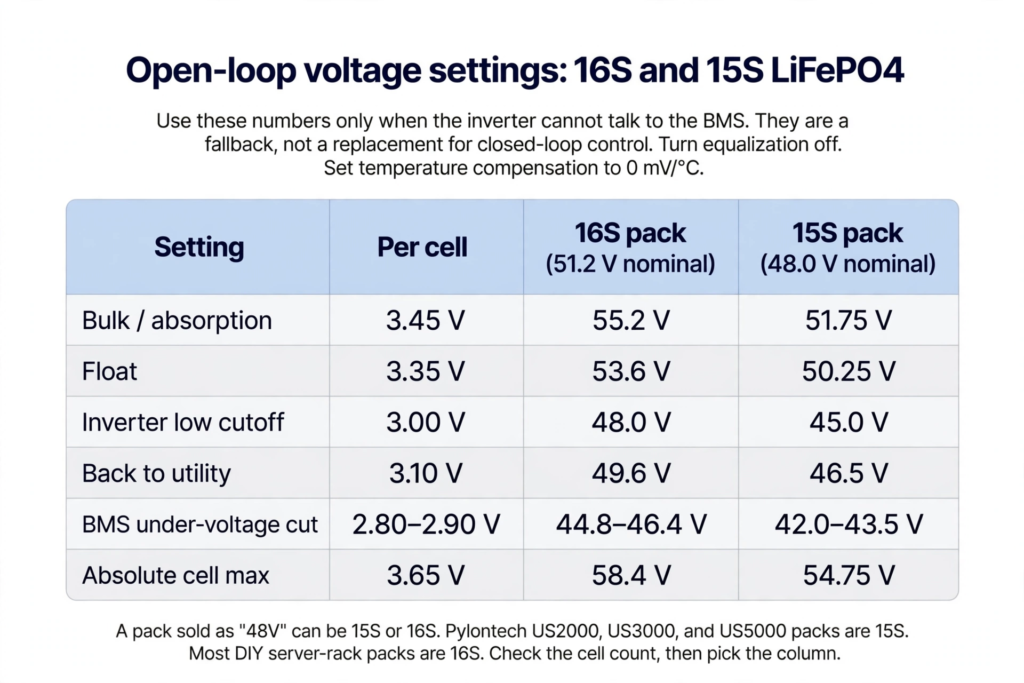
The short answer. For a 16S 51.2 V LiFePO4 pack in open loop mode, set bulk to 55.2 V, float to 53.6 V, and low DC cut-off to 48.0 V. That is 3.45 V, 3.35 V, and 3.00 V per cell, times 16 cells. 16S means 16 cells in a row. LiFePO4 is lithium iron phosphate, the cell type in these packs. Open loop means the inverter cannot talk to the BMS, so it charges by volts only. BMS is the battery’s guard board. Turn equalization off, and set temp comp to 0 mV/°C. Use these numbers only when the inverter cannot talk to the BMS.
One pack, two volt scales
The pack was new, and the numbers were wrong on day one. The installer had left the Growatt on its stock lead-acid settings: bulk 58.4 V, float 54.0 V, cut-off 42.0 V. The BMS tripped on over-volt every sunny morning. The settings were wrong, not the pack.
We set the pack right that morning. Program 05 to USE, Program 19 bulk to 55.2 V, Program 20 float to 53.6 V, Program 21 cut-off to 48.0 V. The next day told us the fix worked. Solar came up at 7 a.m. with the pack at 51.9 V. At 10:40 a.m. it hit 55.2 V, and the charge current tapered from 60 A down to 8 A. At 11:30 a.m. the inverter dropped to float at 53.6 V. The app showed all 16 cells between 3.44 V and 3.46 V, and 100% charge. An hour later, at rest, the pack sat at 54.4 V. That is full. That evening the pack fell to 49.6 V at 9:15 p.m. and the inverter moved the loads to grid. The BMS never cut.
The house next door runs a 15S Pylontech pack on the same model of inverter. Its numbers are lower across the board: bulk 51.75 V, float 50.25 V, cut-off 45.0 V. Same cell type, same chemistry, one cell less. Put the 16S numbers on that 15S pack and the BMS trips on over-volt every time it nears full. Put the 15S numbers on a 16S pack and it stops short every day. The gap is one cell, and the gap in charge volt is 3.45 V.
Check your cell count before you touch a menu
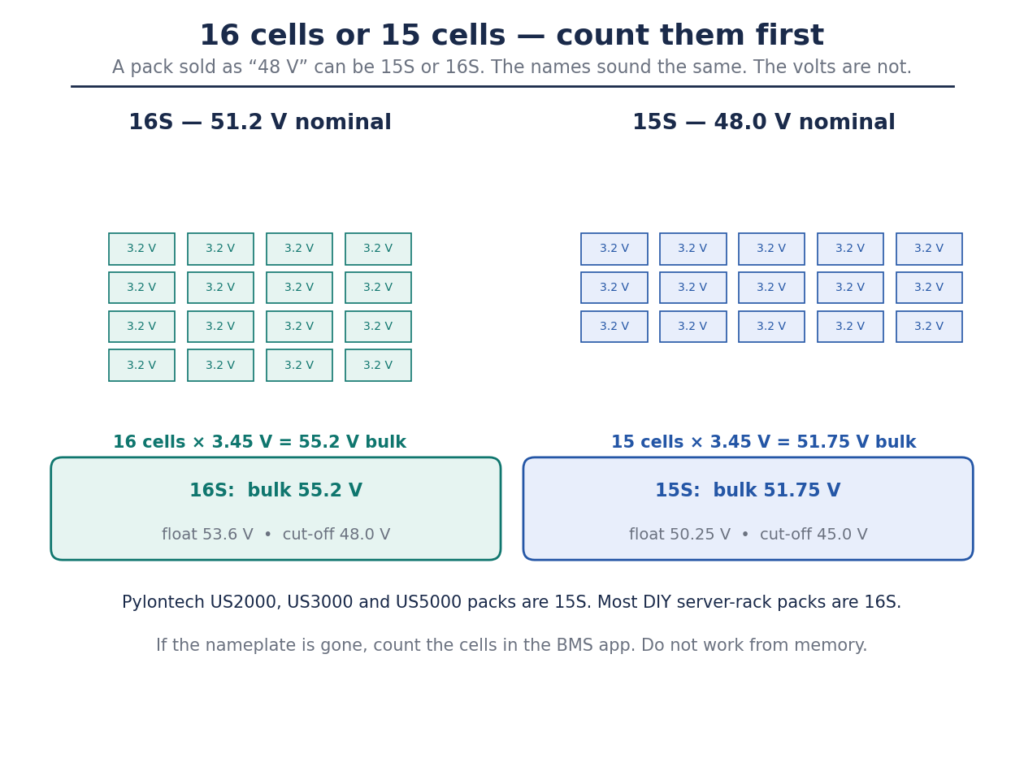
Look at the nameplate and the manual, and count the cells. A pack sold as “48 V” can be 15S or 16S. The names sound the same. The volts are not.
A 15S pack has 15 cells at 3.2 V rated, which is 48.0 V. A 16S pack has 16 cells at 3.2 V rated, which is 51.2 V. Pylontech US2000, US3000, and US5000 packs are 15S, while most home server-rack packs are 16S. If the nameplate is gone, open the BMS app. It shows the cell count and the volt of each cell. Count the cells in the app. Do not work from memory.
The volts: 16S and 15S, kept apart
For 16S, use 55.2 V bulk, 53.6 V float, and 48.0 V low cut-off. That is 3.45 V, 3.35 V, and 3.00 V per cell. For 15S, use 51.75 V bulk, 50.25 V float, and 45.0 V cut-off. That is the same per-cell numbers. Only the pack maths changes. Turn equalization off. Set temp comp to 0 mV/°C. Keep the charge current at 0.3C or below for daily solar charging. 0.3C means 30 A per 100 Ah. That is 60 A per 200 Ah, 84 A per 280 Ah.
| Setting | Per cell | 16S pack (51.2 V nominal) | 15S pack (48.0 V nominal) |
|---|---|---|---|
| Bulk / absorption | 3.45 V | 55.2 V | 51.75 V |
| Float | 3.35 V | 53.6 V | 50.25 V |
| Inverter low cut-off | 3.00 V | 48.0 V | 45.0 V |
| Back to utility | 3.10 V | 49.6 V | 46.5 V |
| Back to battery | 3.30 V | 52.8 V | 49.5 V |
| BMS under-volt cut | 2.80–2.90 V | 44.8–46.4 V | 42.0–43.5 V |
| Absolute cell max | 3.65 V | 58.4 V | 54.75 V |
Bulk is the push. The inverter feeds the pack at the set charge current until the pack hits 55.2 V. Absorption is the hold. The inverter holds 55.2 V while the current falls. This stage ends the charge and gives the balancer time to work. Thirty to 60 minutes is enough. Float is the rest. At 53.6 V, or 3.35 V per cell, the pack sits near full without being held at the knee. Do not set float above bulk.

Why 58.4 V hurts a 16S pack, even when the BMS lets it pass
58.4 V is 3.65 V per cell times 16. That number is real. It is the cell max, printed on datasheets. But it is the wrong daily target.
LiFePO4 cells charge on a curve with a long flat middle and a steep knee at the top. From about 20% to 80% charge, a cell sits near 3.26 V to 3.32 V at rest. Then the curve bends up fast. At 3.40 V the cell is near full at rest. At 3.45 V it is at the top of the knee while charging. At 3.65 V it is at the edge.
That steep knee is where the trouble starts. Push a pack to 58.4 V and you ask every cell to sit at 3.65 V at the same time, but cells are never that even. One cell will always run ahead, and the inverter only sees the pack total. Say fifteen cells sit at 3.60 V and one sits at 3.80 V. The pack reads 57.8 V. The inverter thinks it is fine.
The gain is the part people get wrong. Higher bulk does not mean much more usable power at home. The flat part of the curve holds the energy, while the knee holds a small top slice. At 55.2 V, or 3.45 V per cell, the pack reaches the top of the knee, and the balancer can work there. The cells settle back to about 3.40 V per cell at rest, or 54.4 V for the pack. That is full.
Lead-acid defaults make this worse. Many inverters ship with a flooded bulk of 58.4 V. A flooded battery needs a high bulk to clear sulfate, a crust that forms on lead plates. A LiFePO4 battery needs no such thing. Change the battery type first. On a Growatt SPF 5000 ES, that is Program 05. Set it to USE, or US2 for lithium with no BMS link.
Why volt-based SOC is wrong on LiFePO4
Your inverter shows a percent. In open loop mode, that percent is a guess. It is a guess built on volts. LiFePO4 volts do not track charge in a straight line. SOC means state of charge, how full the battery is, in percent.
At rest, a cell at 80% reads about 3.32 V, at 50% about 3.26 V, and at 20% about 3.20 V. That is a spread of about 0.12 V per cell across 60% of the pack. An inverter under load cannot read it cleanly.
This is why open loop SOC jumps. A pack can sit at 52.0 V for hours, then fall fast once it leaves the flat part. Under load, the volts sag. A pack at 60% can read like 30% while a kettle runs. Under charge, the volts rise. A pack at 60% can read like 90% while solar pushes 40 A in.
Resting volts can still help, if you read them right. Resting volts means the pack sat with no load and no charge for at least 30 minutes. Never read SOC from volts while the pack is charging or under load.
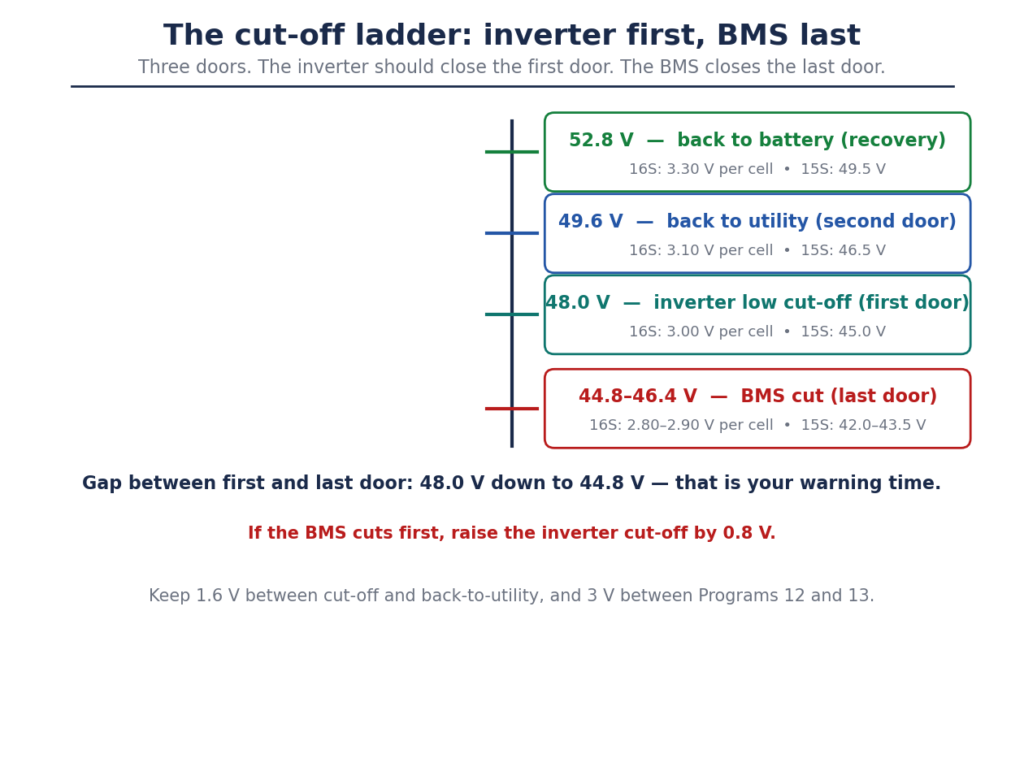
| Resting pack volt (16S) | Resting volt per cell | Rough SOC |
|---|---|---|
| 53.6 V | 3.35 V | About 80% |
| 52.4 V | 3.28 V | About 50% |
| 52.0 V | 3.25 V | About 40% |
| 50.0 V | 3.13 V | About 20% |
| 48.0 V | 3.00 V | About 10% |
The fix is counting, not guessing. A BMS counts amp hours in and out. That count drifts over weeks if the pack never reaches full charge. When the pack reaches 55.2 V and the current tapers, the BMS can reset its count to 100%. Without that reset, the count drifts a little each day. After a month of short charges, it can show 40% when the pack is near empty. So run a full charge weekly. A Victron SmartShunt sits on the battery negative wire and counts current in both directions. Use the shunt or the BMS app for SOC. Use the inverter volts for cut-offs, not a SOC number.
The cut-off ladder: inverter first, BMS last
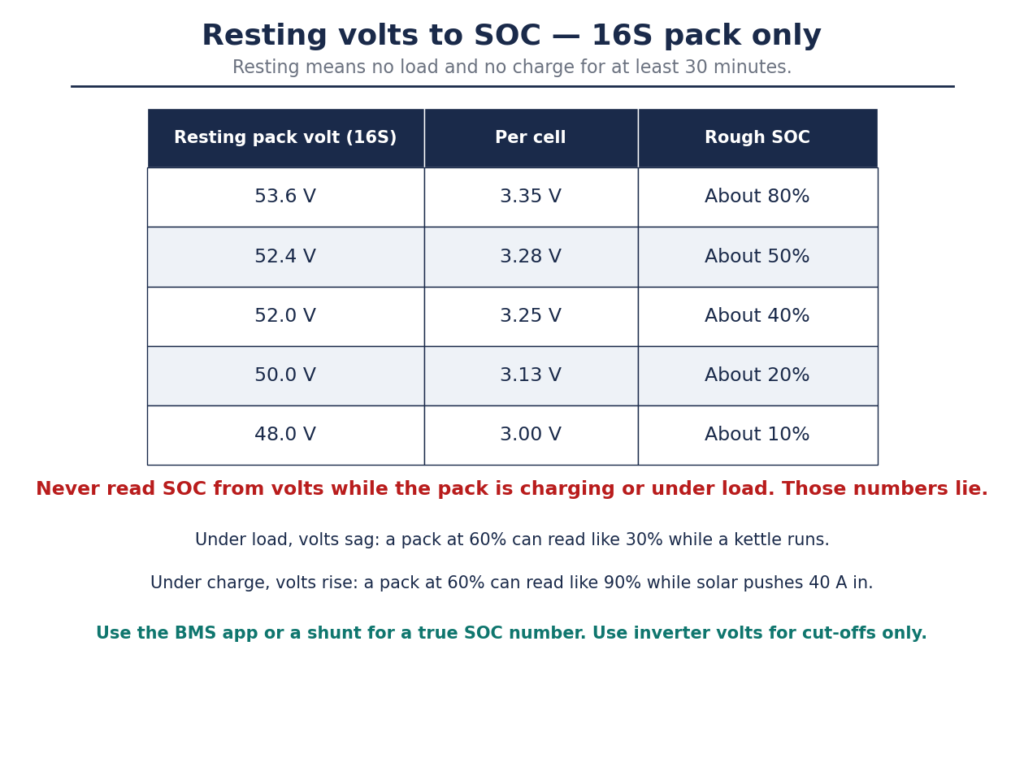
Think of cut-offs as three doors. The inverter should close the first door. The BMS should close the last door. If the BMS has to close the door, something upstream failed.
The first door is the inverter low DC cut-off. Set it to 48.0 V for 16S, which is 3.00 V per cell. At that point the inverter stops drawing from the battery and switches to grid if grid is there. The pack still has a small reserve below 48.0 V. That reserve is for the BMS, not for the kettle.
The second door is the back-to-utility point. Set it higher than the cut-off. A setting of 49.6 V, or 3.10 V per cell, works for most homes. When the pack falls to 49.6 V, the inverter moves loads to grid and starts to charge if grid charge is allowed. Set the gap at 1.6 V, which is 49.6 V minus 48.0 V.
The third door is the BMS under-volt guard, or UVP. Most BMS units cut discharge at 2.80 V to 2.90 V per cell. For 16S, that is 44.8 V to 46.4 V at the pack. For 15S, that is 42.0 V to 43.5 V. That cut is a safety net, not a daily setting or a target to aim for. If the BMS cuts, the inverter loses the battery in one step. Loads drop, and the inverter may need a hand restart. Keep the gap wide so you get warning time to switch to grid or shed a load.
Recovery needs a gap too. A back-to-battery point of 52.8 V, or 3.30 V per cell, is a sound start for 16S, a rise of 4.8 V above the 48.0 V cut-off. The inverter will not flip back and forth every minute. For 15S, the same ladder holds: cut-off 45.0 V, back to utility 46.5 V, BMS cut 42.0 V to 43.5 V, back to battery 49.5 V.
| Door | Who closes it | 16S pack | 15S pack |
|---|---|---|---|
| First door | Inverter low DC cut-off | 48.0 V | 45.0 V |
| Second door | Back to utility | 49.6 V | 46.5 V |
| Third door | BMS under-volt guard | 44.8–46.4 V | 42.0–43.5 V |
| Recovery | Back to battery | 52.8 V | 49.5 V |
Enter the settings in nine steps
Work the steps in order. If a check fails, stop there. The steps below are for a Growatt SPF 5000 ES. If your inverter is a Deye or Sunsynk, use “Use Batt V” mode. If it is a Solis, use “User-Define” mode. If it is an EG4, set the battery type to Lead-Acid. The volts are the same.
- Check the cell count. Read the nameplate or the manual. Count the cells in the BMS app if the nameplate is gone. Write down 15S or 16S. Check: cell count written down.
- Write down the old values. Note the battery type, the bulk, float, and cut-off volts as they are now. Check: old values in hand.
- Set Program 05 to USE. Hold ENTER for three seconds to open settings. Step to Program 05 and set it to USE, or US2 for lithium with no BMS link. This unlocks Programs 19, 20, and 21. Check: Program 05 reads USE, or US2.
- Set Program 19, the bulk volt. Set it to 55.2 V for 16S or 51.75 V for 15S. The manual allows Program 19 from 48 V to 58.4 V. That does not make 58.4 V a good daily setting. Check: Program 19 reads your bulk volt.
- Set Program 20, the float volt. Set it to 53.6 V for 16S or 50.25 V for 15S. Never set float above bulk. Check: Program 20 reads your float volt.
- Set Program 21 and the back-to points. Set Program 21, the low DC cut-off, to 48.0 V for 16S or 45.0 V for 15S. Set Program 12, back to utility, to 49.6 V for 16S or 46.5 V for 15S. Set Program 13, back to battery, to 52.8 V for 16S or 49.5 V for 15S. Check: Program 21 reads your cut-off volt.
- Turn off the lead-acid stages and set the current. Turn equalization off. Set temp comp to 0 mV/°C. Set the max charge current to 0.3C or below: 84 A on a 280 Ah pack. Check: equalization off, temp comp 0, current at or below 0.3C.
- Watch one full charge. Charge on a sunny morning. Watch the pack reach bulk, hold 30 to 60 minutes, then drop to float. On our rig, the pack hit 55.2 V at 10:40 a.m., the current tapered from 60 A to 8 A, and float came at 11:30 a.m. Check the cell spread at the top. Check: pack reaches bulk, current tapers, float follows, cells within 0.10 V.
- Watch one discharge, then write it down. The inverter should switch to grid at 49.6 V and stop drawing at 48.0 V. The BMS should not cut. If it cuts first, raise the inverter cut-off by 0.8 V. Write the final numbers on a card near the inverter, with the date and the cell count. Check: grid switch at 49.6 V, no BMS cut, card written.
What each symptom points to
| What you see. | Most likely cause. | Fix. |
|---|---|---|
| BMS trips on over-volt every sunny morning. | Bulk too high, or wrong cell count. | Set bulk to 55.2 V for 16S, 51.75 V for 15S. |
| Pack never reaches bulk. | Runner cell, or charge current too high. | Check the cell spread, lower bulk to 54.4 V. |
| Inverter cuts at night, screen read 60%. | Volt SOC lied under load. | Use the BMS app for SOC. |
| BMS cuts first, loads drop. | Inverter cut-off too low. | Raise the inverter cut-off by 0.8 V. |
| SOC drifts after weeks of part charge. | No full-charge reset. | Run a full charge weekly. |
| Inverter chatters between grid and battery. | Back-to points too close. | Keep 3 V between Programs 12 and 13. |
What can still go wrong
A balanced pack needs time at bulk.
A pack that has just been top-balanced may need up to two hours at 55.2 V. After that, drop to float. Do not hold the top volt all day. Higher current raises the volts under charge and leaves less time for the balancer. Keep the charge current at 0.3C or below.
Lead-acid volts left in another charger.
Set the same lithium volts on every charge source. Your MPPT, your grid charger, and your inverter should all use the same bulk, float, and cut-off numbers.
Equalization left on.
Equalization is a lead-acid routine. It pushes the pack above bulk on purpose to clear sulfate from lead plates. LiFePO4 has no sulfate to clear. The extra volts only push cells into over-volt and trip the BMS. Turn it off. Set temp comp to 0 mV/°C too. It shifts charge volts with the weather, and LiFePO4 must not have its volts shifted that way. Keep low-temperature charge guard on in the BMS instead.
When to go back to closed loop.
Go back to closed loop when you have a working cable, the right code, and a BMS the inverter lists as supported. Closed loop gives the inverter live SOC, live cell limits, and live charge current limits from the BMS. The inverter can slow solar before a cell trips. Open loop cannot do that. If you fix the link fault, switch Program 05 back to LI on a Growatt, or Lithium mode on a Deye, Solis, or EG4. Keep the open loop numbers written down. You may need them again.
Common questions
Can I use 56.0 V bulk for a little more charge?
You can, but this guide does not. Some guides use 56.0 V to 56.8 V for daily bulk, and some even say 57.6 V. Those numbers come from cell datasheets. They fill the pack a little more, but they hold every cell closer to the edge for longer, and the runner cell trips the BMS more often. At 55.2 V you give up a tiny top slice of charge and gain a wide safety gap.
Why does my pack read 54.4 V at rest when it is full?
Because the cells settle back after charging. At 55.2 V under charge, the cells sit at 3.45 V each. At rest, they settle to about 3.40 V each, or 54.4 V for the pack. That is full. Do not raise the bulk volt to chase a higher resting volt.
My pack is 15S. What changes?
Every volt changes. Bulk 51.75 V, float 50.25 V, cut-off 45.0 V, back to utility 46.5 V, back to battery 49.5 V. The per-cell numbers are the same. Only the pack maths changes. Do not use the 16S numbers on a 15S pack.
How do I read SOC without a BMS link?
You cannot read it well from volts. Resting volts give a rough guide: 53.6 V is about 80%, 52.4 V is about 50%, 50.0 V is about 20% on a 16S pack. Never read SOC from volts while the pack is charging or under load. Use the BMS app or a shunt for a true SOC number.
What if one cell runs ahead at the top?
Lower bulk to 54.4 V for 16S and balance the pack. A cell that runs more than 0.10 V ahead of the rest at the top means the pack is out of balance. No inverter setting fixes that. Top-balance the pack, then set bulk back to 55.2 V.
Do this next
- Check the cell count from the nameplate or manual and write down 15S or 16S. Do not work from memory.
- Set the battery type to USE or US2. Set bulk to 55.2 V, float to 53.6 V, and low cut-off to 48.0 V for 16S. Use 51.75 V, 50.25 V, and 45.0 V for 15S. Turn equalization off. Set temp comp to 0 mV/°C. Set max charge current to 0.3C or below.
- Set back to utility to 49.6 V for 16S, or 46.5 V for 15S. Set back to battery to 52.8 V for 16S, or 49.5 V for 15S.
- Charge on a sunny morning. Watch the pack reach bulk, hold 30 to 60 minutes, then drop to float. Check the cell spread at the top.
- Watch one discharge. The inverter should switch to grid at 49.6 V and stop drawing at 48.0 V. The BMS should not cut. If it cuts first, raise the cut-off by 0.8 V.
- Write the final numbers on a card near the inverter, with the date and cell count.
Sources
Checked on 20 November 2026. Unconfirmed items are labelled “not confirmed” in the text.
- Growatt SPF 5000 ES User Manual. Program 05 USE or US2 for lithium with no BMS link. Program 19 bulk 48–58.4 V, Program 20 float 48–58.4 V, Program 21 low cut-off 40–48 V. Program 02 max charge current 100 A.
- Growatt FAQ via PowerForum (Growatt China reply). If your battery is not on the Growatt list, set Program 05 to US2 and run without BMS data. Current limit under 30 A for a single battery.
- Deye SUN-5K/8K/12K-SG04LP3 User Manual, Battery Setting section. Use Batt V means use battery voltage for all the settings. Absorption, float, shutdown, low battery, and restart volts set by the user.
- EG4 6000XP Manual v1.2.0. Pick the Lead-Acid setting if the lithium battery cannot talk to the inverter. Setting 7 CV range 50–59 V, stock 56.4 V. Setting 8 float range 50–56 V, stock 54 V.
- Pylontech US2000/US3000/US5000 Datasheet. 15S LiFePO4, 48 V nominal.
- LiFePO4 cell datasheets (EVE, CATL). Cell max 3.65 V. Flat curve 3.26–3.32 V per cell from 20% to 80% at rest.
- Victron SmartShunt Manual. Shunt counts current in both directions for true SOC.
- This site: JK BMS to Growatt SPF 5000 ES CAN setup, Growatt Error 20 fix, closed loop vs open loop LiFePO4, Deye Use Batt V mode.
Comments (0)