
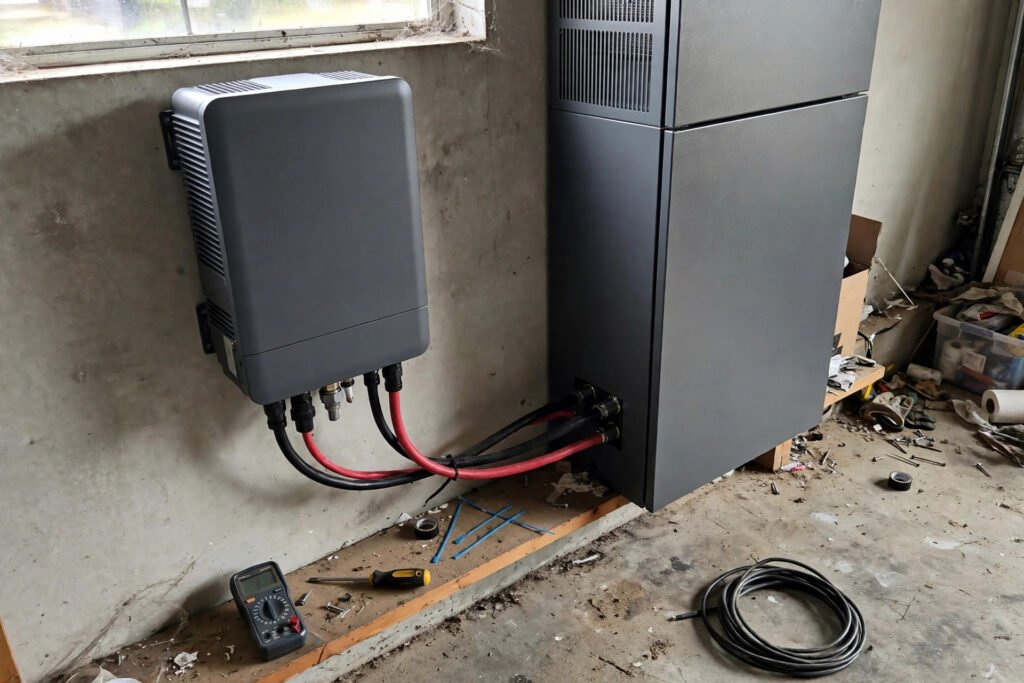
What this guide works from. One rig: a Growatt SPF 5000 ES in USE mode, a DIY 16S pack of 280 Ah EVE cells with a JK BMS (JK-PB2A16S20P), and 6 kW of solar. The pack is 51.2 V rated and holds 14.336 kWh. The owner first set absorption to 58.4 V, the flooded lead-acid default. The BMS cut the charge at 97% full. Then he set it to 55.2 V, and the pack filled to 100% with no cut.
The short answer. For a 16S 51.2 V LiFePO4 pack, set absorption to 55.2 V. That is 3.45 V per cell, times 16 cells. Do not set it to 58.4 V. That is 3.65 V per cell, the hard ceiling where the BMS cuts the charge to save the cells. At 58.4 V one fast cell hits the ceiling before the pack is full, and the whole charge stops. At 55.2 V the pack fills, the cells stay in step, and the BMS never has to cut.
The rig that hit the wall
The house runs on solar and a home-built pack: sixteen 280 Ah cells in a steel case. A JK BMS guards them. It watches each cell and can cut the charge. The inverter is a Growatt SPF 5000 ES. It runs in USE mode: open loop, charging by volts only.
When the pack was new, the owner left the inverter on its lead-acid numbers. Program 19, the bulk volt, sat at 58.4 V. Each sunny morning the pack climbed, then the current fell to zero all at once. The screen showed the pack stuck at 97% full. The BMS app showed cell 14 at 3.65 V while the others sat between 3.53 V and 3.63 V. The pack read 57.6 V. It had never reached 58.4 V.
From 42% full, the pack took in about 7.9 kWh before the cut. A full charge from the same start should take about 8.3 kWh. The BMS count drifted. The owner asked a plain question: what volt should the inverter hold at the top?
The maths: what each volt means per cell
A 16S pack is 16 cells in a row. Pack volts are just per-cell volts times 16. So every pack setting is a per-cell setting in disguise.
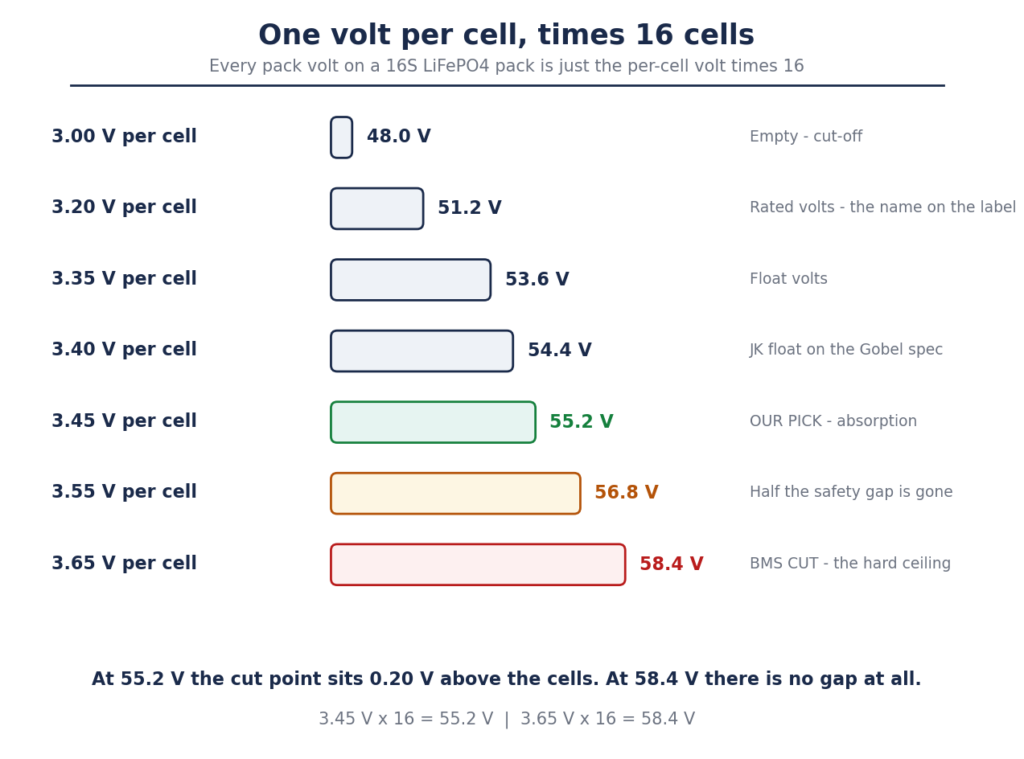
At 3.00 V per cell the pack reads 48.0 V, the low cut-off. At 3.20 V it reads 51.2 V, the rated volts. At 3.35 V it reads 53.6 V, the float volt. At 3.40 V it reads 54.4 V, where a full pack rests. At 3.45 V it reads 55.2 V, our pick. At 3.55 V it reads 56.8 V. At 3.65 V it reads 58.4 V, the ceiling.
| Per cell | 16S pack | What it means |
|---|---|---|
| 3.00 V | 48.0 V | Low cut-off. |
| 3.20 V | 51.2 V | Rated volts. The number on the label. |
| 3.35 V | 53.6 V | Float volt. |
| 3.40 V | 54.4 V | Resting volts of a full pack. |
| 3.45 V | 55.2 V | Absorption. Our pick. |
| 3.55 V | 56.8 V | High daily setting. |
| 3.65 V | 58.4 V | Hard ceiling. The BMS cut point. |
The gap is the whole story. At 55.2 V the cut point sits 0.20 V above the cells. At 58.4 V there is no gap at all.
The same maths works for a 15S pack. A 15S pack at 3.45 V per cell reads 51.75 V. Put 55.2 V on a 15S pack and you ask for 3.68 V per cell, past the ceiling. Full 15S and 16S settings are in the open-loop voltage settings guide.
What the makers actually print
The makers do not agree on one number: some print 54.4 V, some print 58.4 V. Your own battery manual wins.
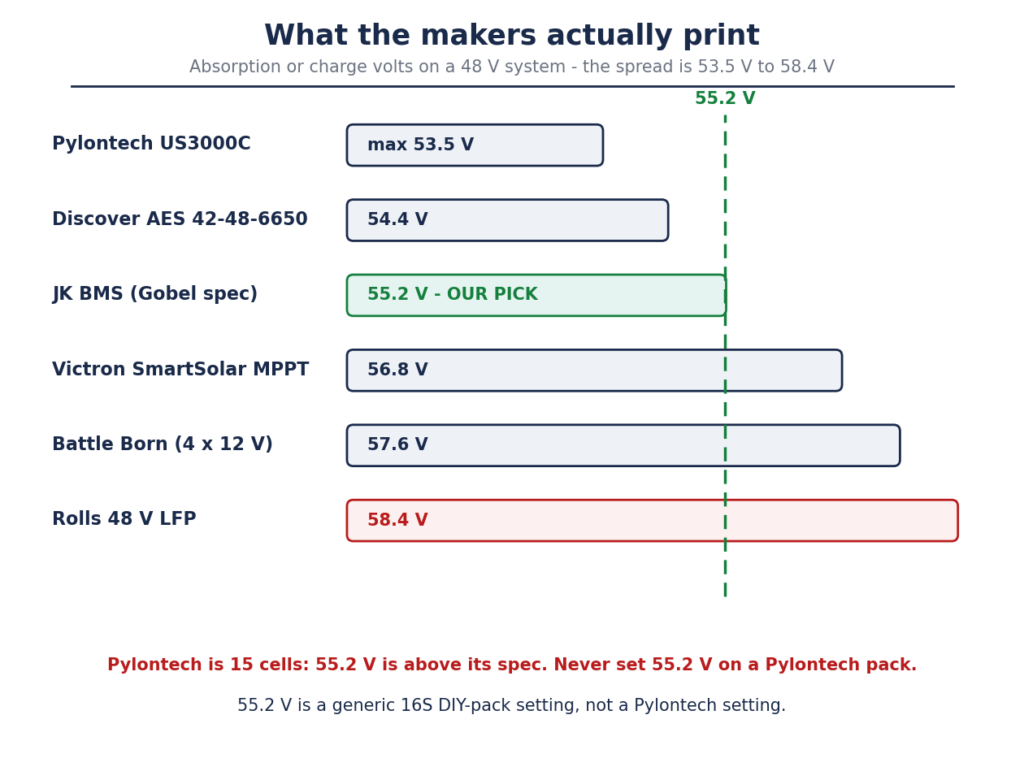
Pylontech prints the lowest number. The US3000C manual gives 52.5 V to 53.5 V, and protection trips above 54 V. Say this plainly: 55.2 V is above the Pylontech spec.
Discover prints 54.4 V for its AES 42-48-6650, with a float of 53.6 V. Its manual says not to charge higher than 3.4 V per cell.
The JK BMS itself points at 55.2 V. The Gobel spec lists 3.45 V per cell as the recommended charge volt. Solar Stack found the same on a real JK-PB board, with a float of 3.35 V per cell.
Victron prints higher: its SmartSolar MPPT manual gives a LiFePO4 default of 14.2 V on a 12 V system, or 56.8 V on a 48 V system. Battle Born prints 14.4 V, or 57.6 V for four in a row.
| Maker and pack | Cells | Absorption or charge volts | Float volts | What it tells us |
|---|---|---|---|---|
| Pylontech US3000C | 15 | 52.5 to 53.5 V | None in the manual | Above its spec. Never use. |
| Discover AES 42-48-6650 | 16 | 54.4 V | 53.6 V, optional | Do not pass 3.4 V per cell. |
| JK BMS, Gobel spec | 16 | 55.2 V (3.45 V per cell) | 54.4 V (3.40 V per cell) | The BMS default charge volt. |
| Victron SmartSolar MPPT default | 4 x 12 V | 56.8 V (14.2 V x 4) | 54.0 V (13.5 V x 4) | A charger default, not a cell spec. |
| Battle Born BB10012 x 4 | 4 x 12 V | 57.6 V (14.4 V x 4) | 54.4 V max (13.6 V x 4) | High volt protection at 58.8 V. |
| Rolls 48 V LFP, four 12 V in a row | 4 x 12 V | 58.4 V | 54.4 V, 3-stage | Its own packs allow it. |
The spread is wide: 53.5 V to 58.4 V. For our rig, 55.2 V is the pick.
Why 58.4V trips the BMS
LiFePO4 has a flat volt curve. Between about 15% full and about 95% full, each cell sits between 3.25 V and 3.35 V. A big charge goes in, and the volts barely move. Then, near the top, the curve bends up fast. This bend is called the knee.
No two cells are exactly alike. One cell always fills a little faster. That cell is the runner. In our rig it was cell 14. At the start of the day all 16 cells read within 0.02 V of each other. By the top of the charge, cell 14 sat 0.12 V above the lowest cell.
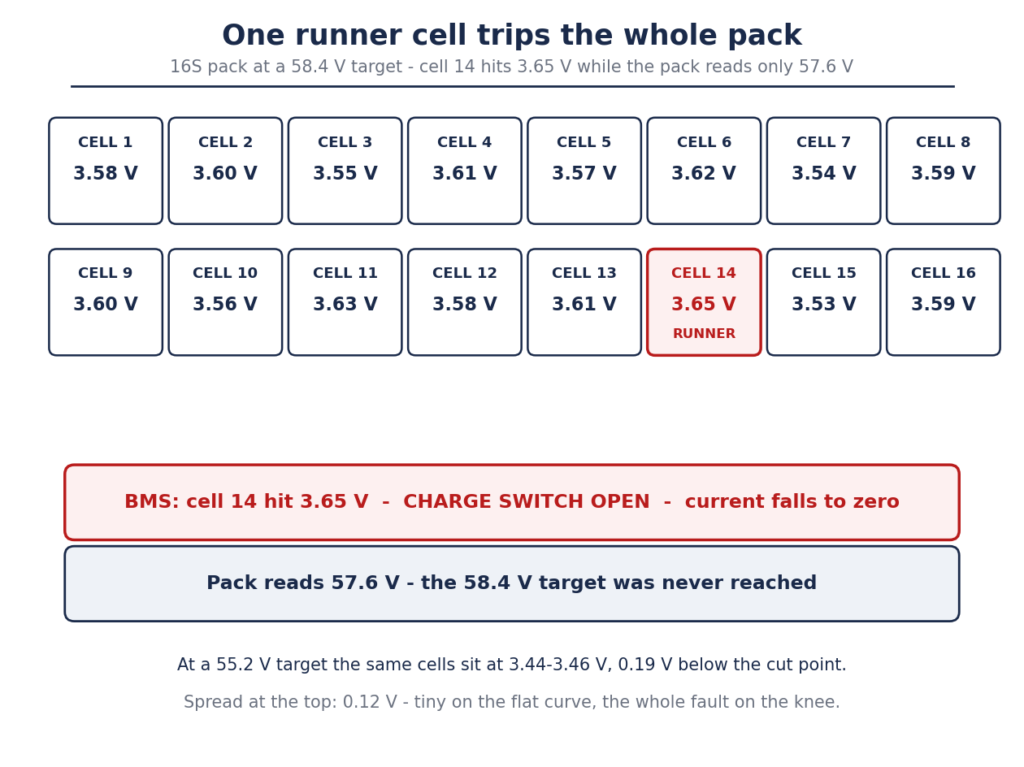
Here is the chain. The inverter pushes 60 A into the pack. The inverter holds its target volt when the pack reaches it. But the inverter only sees pack volts, not single cells. The BMS sees every cell, but in open loop it cannot tell the inverter to slow down. It can only open the charge switch when a cell hits 3.65 V.
At a 58.4 V target, the maths leaves no room. For the pack to reach 58.4 V, the average cell must reach 3.65 V. But the runner gets there first. On our rig the runner hit 3.65 V while the pack read only 57.6 V. The BMS opened the switch. At a 55.2 V target the same runner is harmless. The cells sit between 3.44 V and 3.46 V, 0.19 V below the cut point.
One more fact makes the trip worse: the JK BMS stages watch pack volts, not single cells. One high cell neither starts nor stops a stage, so the BMS will not slow the charge for the runner.
Absorption time and tail current: how to tell it is done
Absorption is the hold. The inverter holds the target volt while the current falls. The hold ends the charge and gives the balancer time to work.
The makers end the hold in three ways. Victron ends it on a fixed time: its SmartSolar MPPT manual gives a LiFePO4 default of 2 hours at 14.2 V, with a tail current of 0 A. Battle Born ends it on time too: 30 minutes per 100 Ah, or 84 minutes on our 280 Ah pack. The JK BMS ends it on time as well: Solar Stack found absorption lasts exactly its RCV Time setting, 30 minutes on the tested board. Discover ends it on current: its manual stops absorption when the current drops below 2 A.
Three makers, three answers: 2 hours, 84 minutes, 30 minutes, and a 2 A current cut. This guide uses the JK rule on our rig: 30 minutes at 55.2 V. The check is the current. On our rig it tapered from 60 A to 5 A across that half hour. Five amps on a 280 Ah pack is under 2% of capacity. Use this rule on your own rig: if the current at the end of absorption has fallen below 2% of your pack’s amp-hours, the pack is full. If the current is still high after 30 minutes, find the cause. The 2% rule is a rule of thumb from this worked case, not confirmed as a maker spec, so treat it as a check, not a law.
Open loop vs closed loop: who sets the volt
In open loop, you set the volt. In closed loop, the BMS sets the volt.
Open loop means no data cable between the BMS and the inverter. The inverter charges by volts only. On our Growatt that is Program 05 set to USE. The BMS watches the cells. It cannot ask for a lower volt. It can only open its switch when a cell hits the ceiling.
Closed loop means the BMS talks to the inverter over CAN or RS485. The BMS sends the charge volt, and the inverter obeys it. On a JK-PB board, the BMS asks for RCV times the cell count while the pack fills. With the factory RCV of 3.45 V per cell, that is 55.2 V on a 16S pack. It holds that ask for RCV Time, then drops to RFV, or 53.6 V. Same number, but the BMS picks it, not you.
If someone raised the RCV in the BMS app to 3.65 V per cell, the BMS would ask for 58.4 V, and the same runner cell would trip the same cut. Check the RCV value in your BMS app. It should read 3.45 V per cell. If it reads 3.65 V, put it back. Going back to closed loop is the best fix, when the cable allows it. See the closed-loop vs open-loop settings guide. If your cable is dead, the same-day Axpert Warning 61 fix walks through a lost link. If your BMS is a brand the inverter will not talk to at all, the same-day Pylontech Huawei third-party BMS guide covers the third-party route.
Set it in order: ten steps, each with a check
Work the steps in order. If a check fails, stop there. These steps are for a Growatt SPF 5000 ES. On a Deye use “Use Batt V” mode. On a Solis use “User-Define” mode. The Solis steps are in the Solis User-Define guide.
- Write down your pack. Count the cells in the BMS app, and write down the amp-hours and BMS model. Check: you know 15S or 16S first.
- Meter the pack at rest. Open the BMS app on a calm morning with no charge and no load, and write down all 16 cell volts. Check: spread 0.10 V or less.
- Check your battery manual. A Pylontech pack caps at 53.5 V, a Discover pack at 54.4 V, a DIY 16S pack with a JK BMS takes 55.2 V. Check: target volt at or below the manual’s max.
- Set Program 05 to USE. Hold ENTER for three seconds, then step to Program 05. Check: Program 05 reads USE.
- Set Program 19, the bulk volt, to 55.2 V for 16S or 51.75 V for 15S. The manual allows up to 58.4 V. Check: Program 19 reads 55.2 V.
- Set Program 20, the float volt, to 53.6 V for 16S or 50.25 V for 15S. Never set float above bulk. Check: Program 20 reads 53.6 V.
- Set Program 21, the cut-off, to 48.0 V for 16S or 45.0 V for 15S. Set Program 12, back to utility, to 49.6 V or 46.5 V. Set Program 13, back to battery, to 52.8 V or 49.5 V. Check: Program 21 reads 48.0 V.
- Turn equalization off and set temp comp to zero. LiFePO4 never needs equalization, a high-volt pulse for lead-acid. Check: equalization OFF, temp comp 0.
- Watch one full charge on a sunny morning. On our rig the pack hit 55.2 V at 10:40 a.m., the current fell from 60 A to 5 A, and float came at 11:30 a.m. Check: pack reaches 55.2 V, current below 6 A, float follows, cells within 0.05 V.
- Watch one discharge. The inverter should move loads to grid at 49.6 V and stop drawing at 48.0 V. The BMS should not cut. Write the numbers on a card near the inverter. Check: grid switch at 49.6 V, no BMS cut, card written.
Read the meter: what the numbers mean
A meter settles most fights about a charge volt. The inverter screen can lag, and its gauge can drift. The meter at the pack posts is the truth.
On our rig the two settings gave two very different days. Both days started the same way: 51.9 V on the pack, 42% full, sun up at 7 a.m., 60 A of charge. The only change was Program 19.
| Reading | At 58.4 V setting | At 55.2 V setting |
|---|---|---|
| Pack volts when charge stopped | 57.6 V. Cut by the BMS. | 55.2 V. Held by the inverter. |
| Highest cell | 3.65 V. Cell 14. | 3.46 V. |
| Cell spread | 0.12 V. | 0.02 V. |
| Charge current at stop | 0 A. BMS switch open. | 5 A. Tapering. |
| Charge level shown | 97%. Stuck. | 100%. |
| Absorption time | 0 min. Cut came first. | 30 min. Then float. |
| Resting volts one hour later | 54.9 V. | 54.4 V. |
| Energy in that day | About 7.9 kWh. | About 8.3 kWh. |
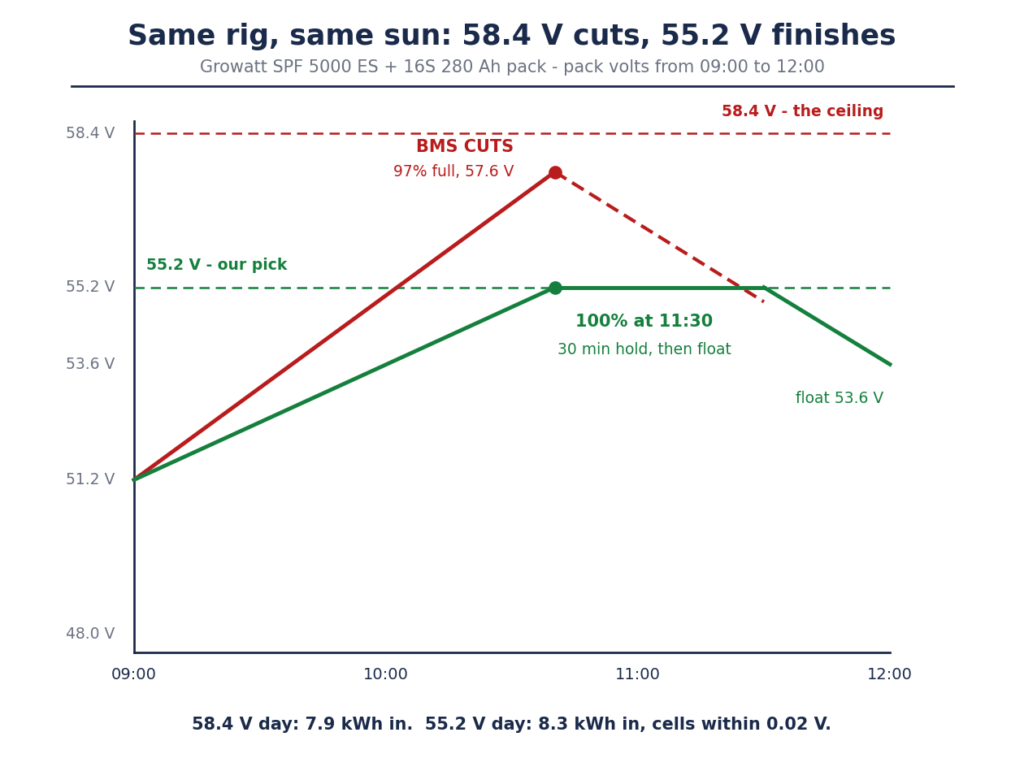
The 58.4 V day looks better on one line and worse on all the rest. The resting volts read higher, 54.9 V against 54.4 V. But that high rest came from a pack that was cut short. The 55.2 V day took in 0.4 kWh more, the cells sat within 0.02 V, and the gauge read a true 100%.
What each symptom points to
If your readings do not match the table above, this table tells you where to look. Read the pack at the posts with a meter. If the meter and the screen disagree by more than 0.2 V, trust the meter.
| What you see | Most likely cause | Fix |
|---|---|---|
| BMS cuts charge near full. Gauge stuck at 95 to 98%. | One cell hit 3.65 V. | Drop absorption to 55.2 V. Balance the pack. |
| Pack never passes 99%. Gauge jumps to 100% then back. | Full-charge volt not held long enough. | Hold 55.2 V for 30 minutes. Check the JK SOC-100% volt. |
| Inverter shows full but pack rests near 53.0 V. | Absorption ended too soon. | Lengthen the hold. Check the tail current is below 6 A. |
| Charge current stays high at 55.2 V and never tapers. | A load is drawing power. Or a cell is weak. | Switch loads off and re-test. |
| BMS trips each sunny morning at the same time. | Runner cell plus a high absorption volt. | Drop to 54.4 V. Top-balance. Then set 55.2 V again. |
| Pylontech pack trips above 54 V. | 55.2 V is above the Pylontech spec. | Use 53.5 V max for Pylontech. Never 55.2 V. |
What can still go wrong
Never use 55.2 V on a Pylontech pack.
Pylontech packs are 15S, and their manual caps charge volts at 53.5 V, with protection above 54 V. The 55.2 V figure is for a generic 16S DIY pack.
Your pack is 15S, not 16S.
A 15S pack at 55.2 V is 3.68 V per cell, past the ceiling. The BMS will trip every day. Count the cells in the BMS app. If it shows 15 cells, use 51.75 V. The same-day Fox ESS H1 pinout shows how a BMS port is wired.
One runner cell still trips the BMS at 55.2 V.
If the BMS still cuts at 55.2 V, the pack is out of balance. A spread above 0.10 V at the top means one cell is far ahead. Drop absorption to 54.4 V. Once the spread is under 0.05 V, set 55.2 V again. If it never closes, the cell may be weak. Testing it is not confirmed as a DIY job.
The JK float volt differs by source.
The Gobel spec lists the JK float volt as 3.40 V per cell, or 54.4 V on 16S. Solar Stack found 3.35 V per cell, or 53.6 V, on a real board. This guide uses 53.6 V.
Why not 58.4 V when Rolls prints it?
Rolls prints 58.4 V for its own 48 V system, and RELiON prints up to 58.4 V. But a DIY pack with a JK BMS is different: its cut point is 3.65 V per cell, and its balancer moves at most 2 A. The extra charge is a small top slice, and its size is not confirmed in any source read for this guide.
A cold pack, or a pack that never fills.
LiFePO4 should not be charged below freezing. The JK BMS stops charging at 0 degrees C, and Victron sets its low temp cut-off at 5 degrees C. On a cold morning the BMS may block charge entirely. The flat-curve SOC guide explains why volts alone cannot tell you the charge level.
Common questions
Will 55.2 V leave my pack short of full?
No. A pack held at 55.2 V fills to 100% and settles to about 54.4 V at rest. The 58.4 V setting only adds a small top slice, and its size is not confirmed in any source read for this guide.
Can I use 56.8 V for a little more charge?
You can. That is 3.55 V per cell, and it still leaves 0.10 V of room below the cut point. But it halves the safety gap.
Why does the BMS cut at 97% and not at 100%?
Because the BMS guards cells, not the pack. It opens the charge switch when any one cell hits 3.65 V. The gauge reads 97% because the pack is not full yet. It only resets to 100% when the cells hold the full-charge volt.
How long should absorption last?
The makers differ. Victron gives 2 hours. Battle Born gives 30 minutes per 100 Ah, or 84 minutes on a 280 Ah pack. The JK BMS held absorption for 30 minutes. This guide uses 30 minutes at 55.2 V: below 6 A at the end means done.
Does this apply in closed loop too?
Yes, but you set it in a different place. In closed loop the BMS sends the charge volt, so check the RCV value in the BMS app. It should read 3.45 V per cell. If it reads 3.65 V, put it back to 3.45 V.
Do this next
- Count your cells in the BMS app and write down 15S or 16S.
- Check your battery manual. If it caps below 55.2 V, use the manual.
- Set the battery type to USE and set absorption to 55.2 V for 16S, float to 53.6 V, cut-off to 48.0 V.
- Turn equalization off and set temp comp to zero.
- Watch one full charge: pack hits 55.2 V, current tapers below 6 A, float follows, cells within 0.05 V.
- Watch one discharge: grid switch at 49.6 V, no BMS cut.
- Write the numbers on a card near the inverter, with the date and the cell count.
- Still stuck? Read the open-loop voltage settings guide or the closed-loop vs open-loop guide, and check the Open-Loop hub.
Sources
Checked on 26 November 2026.
- Growatt SPF 5000 ES manual, via manua.ls. Table 3: flooded bulk 58.4 V, AGM/gel 56.4 V, float 54 V.
- Pylontech US3000C manual, via manua.ls. 15 cells, charge 52.5 to 53.5 V, protection above 54 V.
- JK BMS charging logic, Solar Stack. RCV 3.45 V, RFV 3.35 V, SOC-100% 3.445 V, RCV Time 0.5 h.
- JK BMS Parameter Specification, Gobel Power. OVP 3.65 V, RCV 3.45 V, RFV 3.40 V, balance 2.0 A.
- JK BMS Settings, Clever Solar Power. OVP 3.65 V, OVPR 3.45 V, balance start 3.45 V.
- Victron SmartSolar MPPT manual. Absorption 14.2 V, 2 hours, float 13.5 V, tail current 0 A.
- Charging LiFePO4 Batteries, Battle Born. Absorption 14.4 V, range 14.2 to 14.6 V, float 13.4 to 13.8 V.
- LiFePO4 Charging Voltage Chart, Offgridr. Discover 54.4 V, Pylontech 52.5 to 53.5 V, Rolls 58.4 V, RELiON 56.0 to 58.4 V.
- This site: Open-Loop hub, voltage settings, flat-curve SOC, closed-loop vs open-loop, Solis User-Define, Pylontech Huawei, Fox ESS pinout, Axpert Warning 61.

Comments (0)