
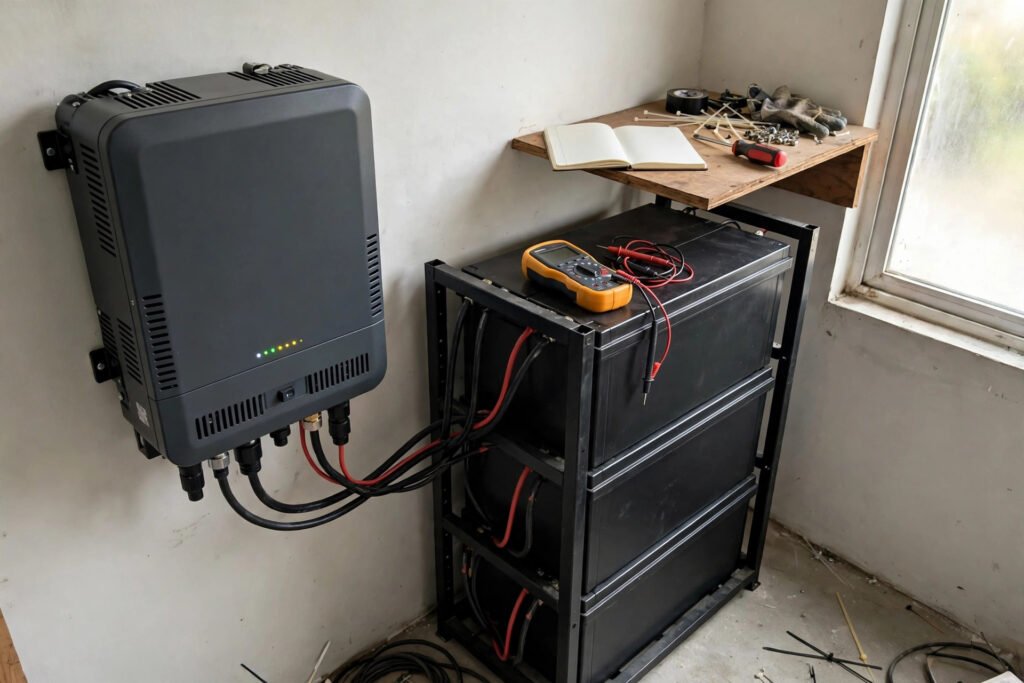
What this guide works from. One rig: a Growatt SPF 5000 ES in USE mode, a DIY 16S pack of 280 Ah EVE cells with a JK BMS (JK-PB2A16S20P), and 6 kW of solar. The pack is 51.2 V rated and holds 14.336 kWh. Float started at the factory default, 54.0 V. After two weeks the cells had drifted and the BMS cut the charge twice. Then he set 53.6 V, and the pack held its balance.
The short answer. For a 16S 51.2 V LiFePO4 pack, set float to 53.6 V. That is 3.35 V per cell, times 16 cells. The 54.0 V factory default is 3.375 V per cell. Both will hold a full pack. But 53.6 V matches the JK BMS float volt, the float volt Deye prints, and the float volt Discover prints for its 16S pack. It sits at the low end of the band where a full pack rests, so the pack truly rests all afternoon. At 54.0 V the pack sits at the top of that band, the cells drift apart a little each day, and the BMS has to cut the next morning charge.
The rig that ran on the factory default
The house runs on solar and a home-built pack: sixteen 280 Ah cells in a steel case. A JK BMS guards them: it watches each cell and can cut the charge. The inverter is a Growatt SPF 5000 ES in USE mode: open loop, charging by volts only. The inverter sets the volts, and the BMS can only open its switch when a cell goes too high.
When the pack was new, the owner set absorption to 55.2 V. That part was right. The absorption guide walks through that setting. But he left Program 20, the float volt, at the factory default of 54.0 V. He never touched it. It looked safe. It is only 0.4 V above 53.6 V.
For the first two weeks, nothing looked wrong. Each morning the pack charged and the gauge read 100%. But the BMS app told a slow story. On day 1 the cells at float sat within 0.02 V of each other. By day 7 the spread was 0.06 V. By day 14 it was 0.11 V. Cell 14, the fast cell, read 3.47 V at float while the lowest cell read 3.36 V. The pack still read 54.0 V. The inverter only sees pack volts, so it saw nothing wrong.
Then the mornings broke. Twice in the second week, the BMS cut the charge during absorption. Cell 14 hit 3.65 V while the pack read only 55.0 V. The gauge stuck at 98%, and the pack never filled that day.
The owner changed one setting: Program 20, from 54.0 V to 53.6 V. Nothing else moved. The next morning the pack filled to 100% with no cut, the cells sat within 0.02 V, and the float afternoons after that held the same spread.
The maths: what 0.4 V means per cell
A 16S pack is 16 cells in a row. Pack volts are just per-cell volts times 16. So a 0.4 V change at the pack is only 0.025 V per cell. That sounds like nothing. On the flat part of the LiFePO4 curve, it is not nothing. It is the whole gap between rest and work.
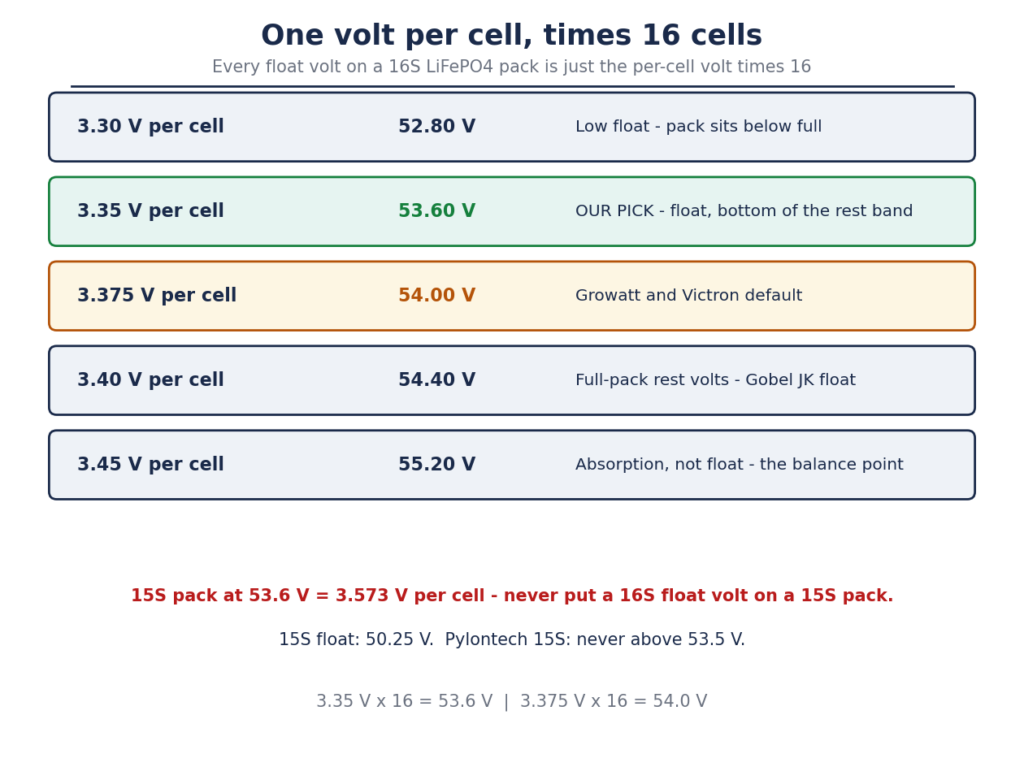
A full LiFePO4 cell rests between 3.35 V and 3.40 V. So a full 16S pack rests between 53.6 V and 54.4 V. Set float to 53.6 V and you hold the pack at the bottom of its rest band, where the cells sit still. Set float to 54.0 V and you hold it near the top, where the cells keep taking a small charge.
| Per cell | 16S pack | 15S pack | What it means |
|---|---|---|---|
| 3.30 V | 52.8 V | 49.5 V | Low float. Pack sits below full. |
| 3.35 V | 53.6 V | 50.25 V | OUR PICK for 16S. Bottom of the rest band. |
| 3.375 V | 54.0 V | 50.6 V | Growatt and Victron default. Top of the rest band. |
| 3.40 V | 54.4 V | 51.0 V | Full-pack rest volts. Gobel JK float. |
| 3.45 V | 55.2 V | 51.75 V | Absorption, not float. The JK balance point. |
The same maths warns you about a 15S pack. A 15S pack at 53.6 V is 3.573 V per cell, far above the rest band and close to the top of the curve. At 54.0 V it is 3.60 V per cell. Never put a 16S float volt on a 15S pack. Count the cells first. Full 15S and 16S settings are in the open-loop voltage settings guide.
What the makers actually print
The makers do not agree on one float volt. The spread runs from 52.8 V to 55.2 V on a 48 V system. Your own battery manual wins.
Pylontech prints no float volt at all. The US3000C manual gives a charge range of 52.5 V to 53.5 V, and protection turns on above 54 V. Say this plainly: 54.0 V sits right on the Pylontech trip line, and 53.6 V is above its 53.5 V max.
Discover prints 53.6 V. Its AES 42-48-6650 manual gives absorption at 54.4 V and float at 53.6 V, called optional, and says not to charge higher than 3.4 V per cell.
The JK BMS prints two different float volts, a real conflict. Solar Stack read the charging logic out of the firmware on a real JK-PB board and found RFV at 3.35 V per cell, or 53.6 V on 16S. The Gobel spec sheet for the same BMS lists RFV at 3.40 V per cell, or 54.4 V. This guide uses 53.6 V: it was read off a live board, not a spec sheet.
Victron prints 54.0 V in one place and 52.8 V in another, inside the same manual. Its SmartSolar MPPT manual gives a LiFePO4 default float of 13.5 V, or 54.0 V on a 48 V system. But its lithium battery table in the same manual gives a float of 13.2 V, or 52.8 V on 48 V. That conflict is real: two Victron pages, two float volts.
Battle Born prints a float range of 13.4 V to 13.8 V for one 12 V battery, or 53.6 V to 55.2 V for four in a row, and says float is not needed for its batteries at all.
Deye prints 53.6 V. Its SUN-5K manual shows Float V at 53.6 V on the Battery Setting page. For lithium it says to follow the BMS volt settings.
Fortress and SimpliPhi print 54.0 V, but they tell inverter owners not to float at all: their sheets say inverter charging is “2 Stage / No Float”.
| Maker and pack | Cells | Float volts | What it tells us |
|---|---|---|---|
| Pylontech US3000C | 15 | None in the manual | Charge 52.5 to 53.5 V. Trip above 54 V. Never 54.0 V. |
| Discover AES 42-48-6650 | 16 | 53.6 V, optional | Do not pass 3.4 V per cell. |
| JK BMS, Solar Stack test | 16 | 53.6 V (RFV 3.35 V) | Read off a live board. Our pick. |
| JK BMS, Gobel spec | 16 | 54.4 V (RFV 3.40 V) | Conflicts with Solar Stack. |
| Victron SmartSolar MPPT | 4 x 12 V | 54.0 V (13.5 V x 4) | Default. Its lithium table says 52.8 V. |
| Battle Born BB10012 x 4 | 4 x 12 V | 53.6 to 55.2 V | Float not needed. Under 54.4 V is fine. |
| Deye SUN-5K manual | 16 | 53.6 V shown | Follow the BMS for lithium. |
| Fortress eVault / SimpliPhi PHI | 16 | 54.0 V | Inverter charging: no float. |
So does 54.0 V have any maker backing, or is it just a common default? It has backing: Victron, Fortress, and SimpliPhi all print 54.0 V. But it is also the Growatt factory default, and that default comes from lead-acid: the Growatt manual gives a 54.0 V float for flooded, AGM, and gel packs. The 53.6 V pick is not the only right answer. It is the safer default for a DIY open-loop pack, because it matches the JK BMS, Deye, and Discover, and it gives the cells a true rest.
Why float voltage matters on the flat curve
Float is the hold after the fill. The inverter holds a set volt while the pack is full and the sun is still up. On lead-acid, float matters a lot: the pack leaks charge on its own. On LiFePO4, it barely matters for the fill: a pack loses only about 2 to 3% of its charge per month on its own, and it is already full when float starts. Float only decides what the cells do for the next five hours.
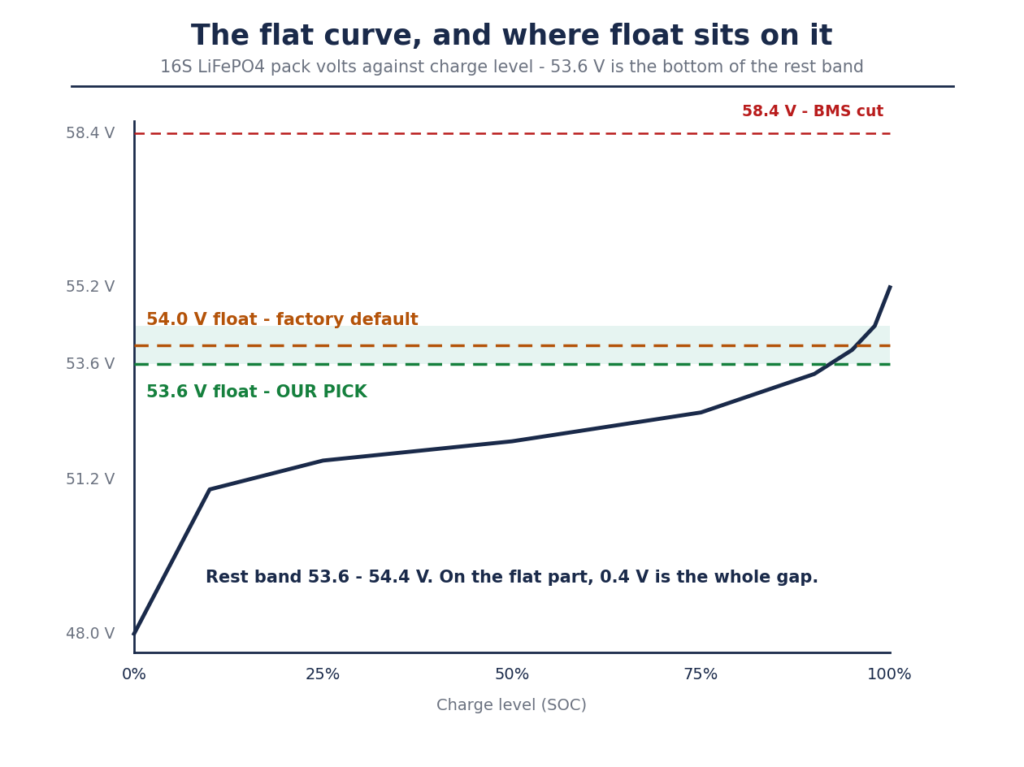
LiFePO4 has a flat volt curve. Between about 15% full and about 95% full, each cell sits between 3.25 V and 3.35 V. A big charge goes in, and the volts barely move. Then, near the top, the curve bends up fast. This bend is called the knee, and on it a tiny bit of charge moves the volts a lot.
Here is the chain that broke our rig. At 54.0 V float, the pack sits at the top of the rest band. The inverter keeps pushing a small current, about 1.2 A on our rig, to hold that volt. That current has to go somewhere. The cells are not all alike. One cell always takes charge a little faster. That cell is the runner. In our rig it was cell 14. At 54.0 V, cell 14 crept up a little each afternoon: 3.39 V at 11:10, 3.40 V at 13:00, 3.41 V at 15:30. The other cells stayed near 3.36 V to 3.38 V. The pack still read 54.0 V, because the inverter only sees the sum.
The BMS could not fix it. The JK BMS starts to balance at 3.45 V per cell. At float, the runner sat at 3.39 V to 3.41 V, below the balance point. So the balancer never started. The gap grew a little each day: 0.02 V, then 0.06 V, then 0.11 V over two weeks.
Then the next morning, absorption made it worse. Absorption holds the pack at 55.2 V, and on the knee the spread opens up. Cell 14 hit 3.65 V while the pack read only 55.0 V. The BMS opened its charge switch. The charge stopped at 98% full.
At 53.6 V float, the chain never starts. The pack sits at the bottom of the rest band, the float current falls to about 0.8 A, near zero, and the cells sit at 3.34 V to 3.36 V all afternoon. The spread holds at 0.02 V. The next morning, absorption fills the pack with the cells in step, and the BMS never has to cut. The exact cause of the slow drift at 54.0 V is not confirmed in any source read for this guide, but the readings are plain: the spread grew at 54.0 V and held at 53.6 V, on the same rig, in the same sun.
Set it in order: ten steps, each with a check
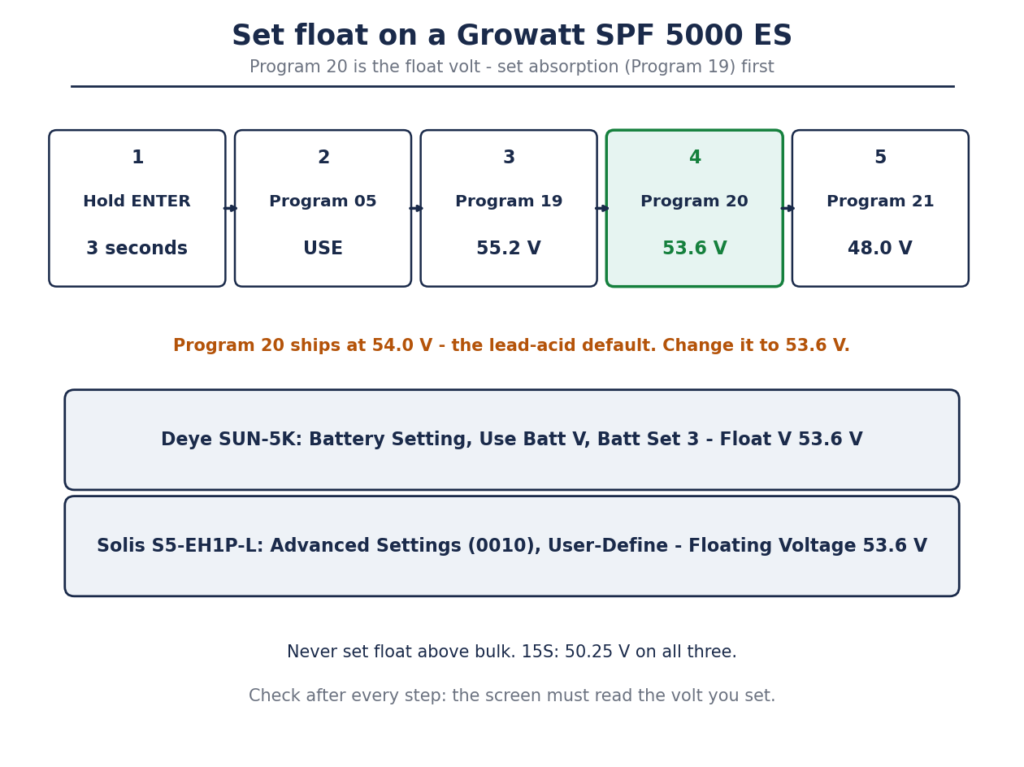
Work the steps in order. If a check fails, stop there. These steps are for a Growatt SPF 5000 ES. On a Deye use “Use Batt V” mode; on a Solis use “User-Define” mode, in the Solis User-Define guide.
| Inverter | Menu path | Float 16S | Float 15S | Note |
|---|---|---|---|---|
| Growatt SPF 5000 ES | Program 05 USE, then Program 20 | 53.6 V | 50.25 V | Factory default 54.0 V. |
| Deye SUN-5K | Battery Setting, Use Batt V, Batt Set 3 | 53.6 V | 50.25 V | Manual shows Float V 53.6 V. |
| Solis S5-EH1P-L | Advanced Settings (password 0010), User-Define | 53.6 V | 50.25 V | Manual example float is 53.5 V for lead-acid. Lithium sets its own volts over CAN. |
- Write down your pack. Count the cells in the BMS app, and write down the amp-hours and BMS model. Check: you know 15S or 16S first.
- Meter the pack at rest. On a calm morning with no charge and no load, write down all 16 cell volts in the BMS app. Check: spread 0.10 V or less.
- Check your battery manual. A Pylontech pack caps at 53.5 V, a Discover pack floats at 53.6 V, a DIY 16S pack with a JK BMS floats at 53.6 V. Check: float volt at or below the manual’s max.
- Set Program 05 to USE. Hold ENTER for three seconds, then step to Program 05. Check: Program 05 reads USE.
- Set Program 19, the bulk volt, to 55.2 V for 16S or 51.75 V for 15S. Float is the partner setting to absorption, so set absorption first. Check: Program 19 reads 55.2 V.
- Set Program 20, the float volt, to 53.6 V for 16S or 50.25 V for 15S. Never set float above bulk. Check: Program 20 reads 53.6 V.
- Set Program 21, the cut-off, to 48.0 V for 16S or 45.0 V for 15S. Set Program 12, back to utility, to 49.6 V or 46.5 V, and Program 13, back to battery, to 52.8 V or 49.5 V. Check: Program 21 reads 48.0 V.
- Turn equalization off and set temp comp to zero. LiFePO4 never needs equalization. Check: equalization OFF, temp comp 0.
- Watch one full float afternoon. On our rig the pack hit 55.2 V at 10:40 a.m., the current fell from 60 A to 5 A, and float came at 11:10 a.m. Check: pack holds 53.6 V, float current under 1 A, cells within 0.05 V.
- Watch the next morning. The pack should fill to 55.2 V, hold for 30 minutes, and drop back to float with no BMS cut. Write the numbers on a card near the inverter. Check: gauge reads 100%, no BMS cut, card written.
Read the meter: what the numbers mean
A meter settles most fights about a float volt. The inverter screen can lag, and its gauge can drift. The meter at the pack posts is the truth. Volts alone cannot show the charge level on the flat curve, so the SmartShunt guide shows how to count amp-hours for a true reading.
On our rig the two settings gave two very different weeks. Both days started the same way: 51.9 V, 42% full, sun up at 7 a.m., 60 A of charge. The only change was Program 20.
| Reading | At 54.0 V float | At 53.6 V float |
|---|---|---|
| Highest cell when float began | 3.39 V. Cell 14. | 3.36 V. |
| Highest cell at 15:30 | 3.41 V. Cell 14. | 3.36 V. |
| Cell spread at 15:30 | 0.05 V. | 0.02 V. |
| Float current at 13:00 | 1.2 A. | 0.8 A. |
| Pack volts one hour after float | 53.9 V. | 53.6 V. |
| Spread after two weeks | 0.11 V and still growing. | 0.02 V and holding. |
| Next morning absorption | Cut twice at 98%. Cell 14 hit 3.65 V. | Full, 100%. No cut. |
| Energy in on the charge day | About 8.1 kWh. Cut came first. | About 8.3 kWh. |
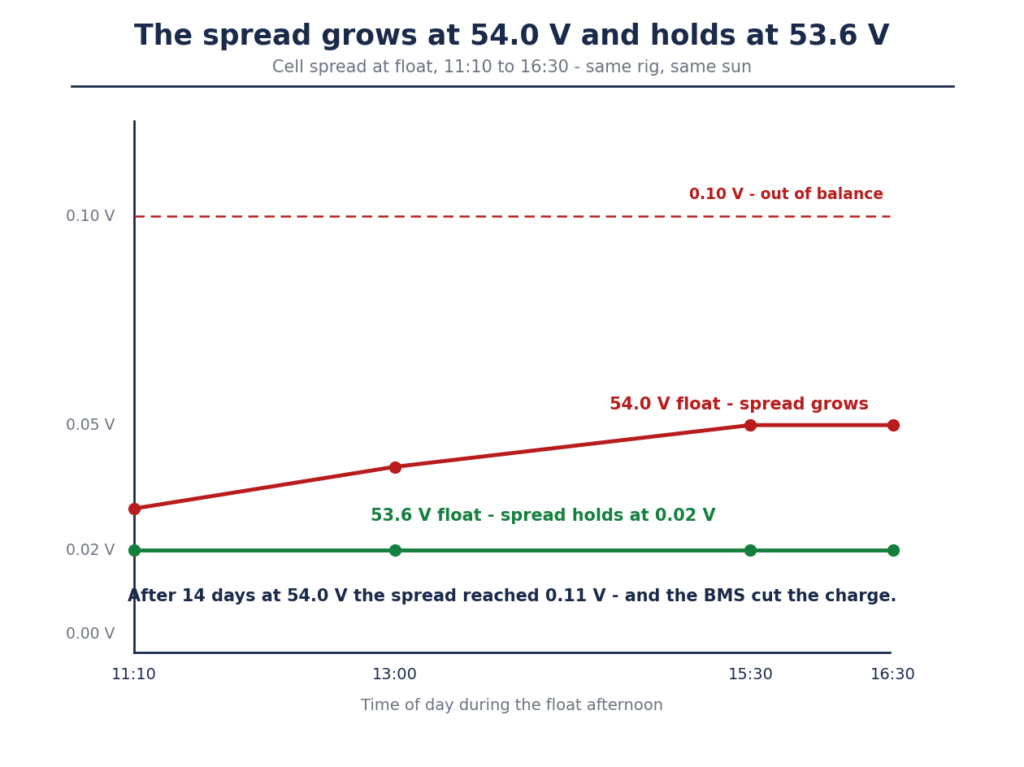
The 54.0 V day looks fine on any single line: the pack reads higher and the gauge reads 100%. But the spread tells the truth: it grows at 54.0 V and holds at 53.6 V. The 53.6 V day took in 0.2 kWh more, the cells sat within 0.02 V, and the gauge read a true 100%.
What can still go wrong
Never use 54.0 V, or 53.6 V, on a Pylontech pack.
Pylontech packs are 15S, and their manual caps charge volts at 53.5 V, with protection above 54 V. The 54.0 V float sits right on the trip line, and 53.6 V is still above the 53.5 V max. The manual gives no float figure at all. If you run a Pylontech pack in open loop, set float to 52.5 V, the low end of its charge range. The same-day Pylontech to SMA guide shows how a Pylontech pack talks to an inverter instead.
Your pack is 15S, not 16S.
A 15S pack at 53.6 V is 3.573 V per cell, and at 54.0 V it is 3.60 V per cell. Both sit near the top of the curve, and the BMS will trip. Count the cells in the BMS app. If it shows 15 cells, use 50.25 V for float. The same-day SolaX pinout guide shows how a BMS port is wired.
One runner cell still creeps up at 53.6 V.
If the spread still grows at 53.6 V, the pack is out of balance. A spread above 0.10 V at the top means one cell is far ahead. Drop absorption to 54.4 V for a week so the balancer has time to work, then set 55.2 V again. If the spread never closes, the cell may be weak. Testing it is not confirmed as a DIY job.
The JK float volt differs by source.
The Gobel spec lists the JK float volt as 3.40 V per cell, or 54.4 V on 16S. Solar Stack found 3.35 V per cell, or 53.6 V, on a real board. This guide uses 53.6 V. Check the RFV value in your BMS app: it should read 3.35 V per cell.
Victron’s own manual prints two float volts.
The SmartSolar MPPT manual gives a LiFePO4 default float of 13.5 V in one section, or 54.0 V on a 48 V system, and 13.2 V in its lithium battery table, or 52.8 V on 48 V. Both figures are in the same manual. If you run Victron gear, check your battery manual first.
You can turn float off, and some makers say you should.
Battery University lists float for LiFePO4 as “No charge” and writes that long float shortens battery life. Fortress and SimpliPhi tell inverter owners to use two stages and no float. Deye has a “Disable Float Charge” tick box for lithium packs with BMS comms. Turning float off is fair on a closed-loop rig, where the BMS sets the volts. On an open-loop rig, keep a float volt set: with no float, the inverter has no hold volt.
54.0 V is the Growatt factory default, and changing it is safe.
Program 20 ships at 54.0 V. That default comes from lead-acid, where the manual gives a 54.0 V float for flooded, AGM, and gel packs. Changing it to 53.6 V does not void anything. It only changes the hold volt after absorption.
Common questions
Will 53.6 V leave my pack short of full?
No. Float starts after absorption, and the pack is already full by then. A full pack rests between 53.6 V and 54.4 V, so 53.6 V holds it at the bottom of its full rest band, and the gauge still reads 100%. The flat-curve SOC guide explains why volts alone cannot tell you the charge level.
Is 54.0 V wrong?
No. Victron, Fortress, and SimpliPhi all print 54.0 V, and a balanced 16S pack will run fine on it. But 53.6 V is the safer default for a DIY open-loop pack: it matches the JK BMS float volt, Deye, and Discover, and it gives the cells a true rest. If your spread holds at 54.0 V, you do not have to change it. If the spread grows, change it.
Why does my BMS cut in the morning after float afternoons?
Because the spread grew during float. At 54.0 V the runner cell creeps up a little each afternoon, below the 3.45 V balance point, so the balancer never starts. The next morning, absorption pushes the pack onto the knee and the runner hits 3.65 V first. The fix is to drop float to 53.6 V and let one full absorption hold balance the pack. The same-day Axpert Error 69 and 70 guide covers what a BMS cut looks like from the inverter side.
Does this apply in closed loop too?
Yes, but you set it in a different place. In closed loop the BMS sends the float volt, so check the RFV value in the BMS app. It should read 3.35 V per cell. If it reads 3.40 V, that is the Gobel spec figure, and it is also fine. If it reads 3.375 V, lower it to 3.35 V.
Do this next
- Count your cells in the BMS app and write down 15S or 16S.
- Check your battery manual. If it caps below 53.6 V, use the manual. Pylontech caps at 53.5 V.
- Set battery type to USE: absorption 55.2 V for 16S, float 53.6 V, cut-off 48.0 V.
- Turn equalization off and set temp comp to zero.
- Watch one full float afternoon: pack holds 53.6 V, float current under 1 A, cells within 0.05 V.
- Watch the next morning: pack fills to 55.2 V, holds 30 minutes, drops to float, no cut.
- Write the numbers on a card near the inverter, with the date.
- Still stuck? Read the absorption guide or the open-loop voltage settings guide, and check the Open-Loop hub.
Sources
Checked on 27 November 2026.
- Growatt SPF 5000 ES manual, via manua.ls. Program 19 bulk 48 to 58.4 V, Program 20 float 48 to 58.4 V, default 54.0 V, Program 21 cut-off 40 to 48 V.
- Pylontech US3000C manual, via manua.ls. 15 cells, charge 52.5 to 53.5 V, protection above 54 V.
- JK BMS charging logic, Solar Stack. RCV 3.45 V, RFV 3.35 V, SOC-100% 3.445 V, RCV Time 0.5 h, read off firmware V19.34 on a live board.
- JK BMS Parameter Specification, Gobel Power. OVP 3.65 V, RCV 3.45 V, RFV 3.40 V, balance 2.0 A.
- Victron SmartSolar MPPT manual. LiFePO4 default absorption 14.2 V, 2 hours, float 13.5 V; lithium table float 13.2 V.
- Charging LiFePO4 Batteries, Battle Born. Absorption 14.4 V, range 14.2 to 14.6 V, float under 13.6 V, float not needed.
- Deye SUN-5K-SG03LP1-EU manual, via deyeinverter.com. Battery Setting page: Float V 53.6 V, Absorption V 57.6 V, lithium follows the BMS.
- Solis S5-EH1P-L battery settings, SolarNevs. Floating Voltage example 53.5 V, Advanced Settings password 0010.
- LiFePO4 Charging Voltage Chart, Offgridr. Discover 54.4 V absorption, 53.6 V float optional; Fortress and SimpliPhi 54 V, inverter charging “2 Stage / No Float”; Battery University float “No charge”.
- LiFePO4 Battery Float Voltage Guide, Evlithium. Float 3.30 to 3.35 V per cell, full pack rests 3.35 to 3.40 V per cell.
- LiFePO4 Voltage Chart, Layout Calculator. Float 3.375 V per cell, 54.0 V on 16S, 50.6 V on 15S.
- This site: Open-Loop hub, absorption guide, voltage settings, flat-curve SOC, SmartShunt, Solis User-Define, Pylontech SMA, SolaX pinout, Axpert Error 69 and 70.

Comments (0)