

What this guide works from. One rig: a Luxpower SNA 5000, a JK Inverter BMS (PB series) on a 16-cell LiFePO4 pack, 280 Ah, resting at 53.1 V, JK app showing 62% charge, W000 on first start.
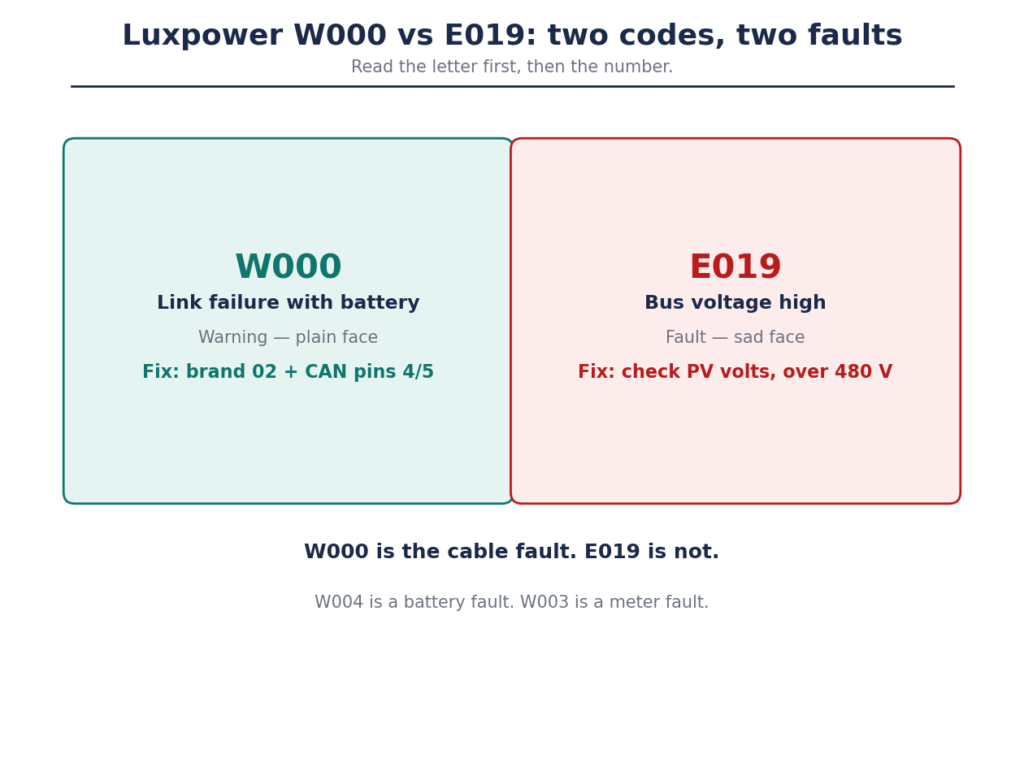
The short answer. W000 means the inverter cannot hear the battery BMS, the battery management system. It is the small board that guards the cells and sends charge data. The fix is almost never a new inverter. On our rig, the fix was two small slips: the cable sat in the JK BMS RS485 port while the inverter waited for CAN, and Program 03 held brand 00, the plain type, not brand 02, Pylon. CAN is fast, and RS485 is older and slower. They do not talk to each other. We moved one plug to the CAN port, set brand 02, and W000 cleared in under two minutes.
The rig that would not link
It was a new build. The SNA 5000 sat on the wall, and the battery box held 16 LiFePO4 cells. A JK Inverter BMS sat on top of the pack. The pack read 53.1 V: 3.32 V per cell, times 16 cells. The JK app showed all 16 cells near 3.32 V, and 62% charge. Then the inverter was switched on. W000 showed within seconds. The screen showed a plain face, not a sad face, and the house still had power. But the battery page was blank: no SOC, no charge limit, no cell temps. SOC is how full the battery is. The inverter still saw 53.1 V on the thick DC cables, but it had no data. Without data, it charges by volts alone. It cannot see the true SOC, and it cannot slow down when a cell runs high.
W000 is not E019
Many web lists call the battery link fault “Error 19.” That is wrong. On the Luxpower SNA and LXP, E019 means bus voltage high. The bus is the high volt path in the box. It links solar, battery, and AC out. E019 has naught to do with the battery cable. The SNA manual says to check if the PV input is higher than 480 V. If E019 keeps coming back, the fault sits in the inverter or on the DC bus. The battery link fault is W000, a warning. Codes that start with E are faults. The box stops, and the screen shows a sad face. Codes that start with W are warnings. The box keeps running, and the screen shows a plain face. W000 is a warning. The box still works, but it gets no live data from the battery. The full guide is the Luxpower SNA / LXP BMS port pinout.
| Code | What it means. | First fix. |
|---|---|---|
| W000 | Link failure with battery. | Program 03 brand 02, CAN pins 4 and 5. |
| E019 | Bus voltage high. | Check PV volts, call Luxpower if it stays. |
| W004 | Battery failure. | BMS reports a pack fault, restart the battery. |
| E008 | CAN error in parallel set. | Check the parallel link cable and settings. |
| W003 | Link failure with meter. | Check the meter power and cable. |
W004 means the BMS found a fault in the pack. Fix the battery, not the cable. E008 means a CAN fault in a parallel set. W003 means a meter fault, like Growatt Warning 401. Do not chase the battery cable for a meter code. Read the letter first, then the number.
Program 03 and brand 02
The Luxpower SNA manual puts the battery setting in Program 03. Open the LCD settings, set the battery type to Li-ion, then pick the battery brand. Field builds use brand 02, the PYLON brand. One SNA 5K report used CAN mode “PYLON +” and brand 2. The SNA 5000 manual brand list reads: 0 plain, 2 Pylon, 6 Luxpower mode, 8 Dyness. Brand 02 is the safe pick for a JK BMS on its Pylon CAN mode. Brand 06 fits a pack that speaks the Luxpower mode. If brand 02 will not link, try brand 06 before you rewire a thing.
Each brand code loads a distinct set of data frames. A wrong brand code means the inverter waits for frames the BMS never sends. The BMS may be talking fine, but the inverter is listening on the wrong path, and W000 stays on the screen. This is the most common cause of W000. A firmware change can move or rename the brand codes, so if W000 showed up right after an update, check the brand again before you rewire a thing. The type must be Li-ion, not lead-acid or user mode. Lead-acid mode is volts-only by design. It never talks to the BMS, so it never clears W000. Switch it back to Li-ion and brand 02, save it, and restart. Give it two minutes.
| Setting | What to pick. | Why it matters. |
|---|---|---|
| Program 03, battery type | Li-ion. | Lead-acid mode never talks to the BMS. |
| Program 03, brand | 02 (PYLON). | Loads the Pylon CAN frames the JK BMS sends. |
| Brand 06, if 02 fails | Luxpower mode. | Fits a pack that speaks the Luxpower mode. |
| JK app, CAN mode | Pylontech CAN, 500 kbps. | Must match the wired link and the brand. |
| JK DIP switches | 1000, one pack. | Switch 1 ON, the rest OFF, master address 0. |
Why the link stays dead
W000 is a handshake fault. A handshake is the short exchange where two units agree they can talk. The inverter sends a frame on the CAN bus: one short packet of data. The BMS must answer with its own frame: SOC, charge limit, cell volts, temps, alarms. If no answer comes back in time, the inverter raises W000 and stops trusting the pack. The talk can fail in only four ways: the wire is wrong, the port is wrong, the brand is wrong, or the bus is broken. A reboot fixes none of these. One rare case: the BMS was asleep and woke up in the power cycle. That is luck, not a fix.
A plain Ethernet patch lead is the most common wire fault. The Pylontech box ships a normal UTP Cat5 cable. It works on some Luxpower units but not on all. A straight lead joins all eight pins. CAN and RS485 join at the same time, and the bus stays mute. On our rig, the lead was fine. It sat in the wrong socket. A good cable in the wrong port fails just like a bad cable in the right port. Brand 00 on a CAN wire hears nothing. The inverter waits for frames the BMS never sends. Check the wire and the port first, then check the menu.
The cable: pins 4 and 5, and the old pin 3 trap
On the SNA port, pin 4 is CAN-H and pin 5 is CAN-L. RS485B sits on pin 1 and RS485A on pin 2. Pins 6, 7, and 8 carry nothing. Count pins with the clip facing away from you, pin 1 on the left. Wire H to H and L to L. Never wire H to L. Use the socket marked CAN on the BMS board, not RS485-1 and not the parallel link socket. On the JK PB board, CAN-H is on pin 4 and CAN-L on pin 5, but some board drawings swap them. Read the print on your own board, and wire H to H and L to L. That is the rule the JK BMS to Luxpower SNA / LXP setup uses too.
Older SNA units put CAN-L on pin 3, not pin 5. Check your manual and the label on the box. A cable made for a new unit will not work on an old one. Build the cable by hand, or buy one made for this exact pair. Use a short shielded twisted-pair cable, Cat5e or Cat6. Shielded means the wires sit in a shield that blocks noise. Keep CAN-H and CAN-L on the same twisted pair, often the blue pair in T-568B, pins 4 and 5. Do not run it tight against the DC battery cables or the AC output wires, and do not plug it into the parallel port or the meter port. Meter it first: each pin must go to the same pin at the far end, with no shorts to the pin next to it. One stray strand between pins 4 and 5 will hold the link down.

Fix it in order: nine steps, each with a check
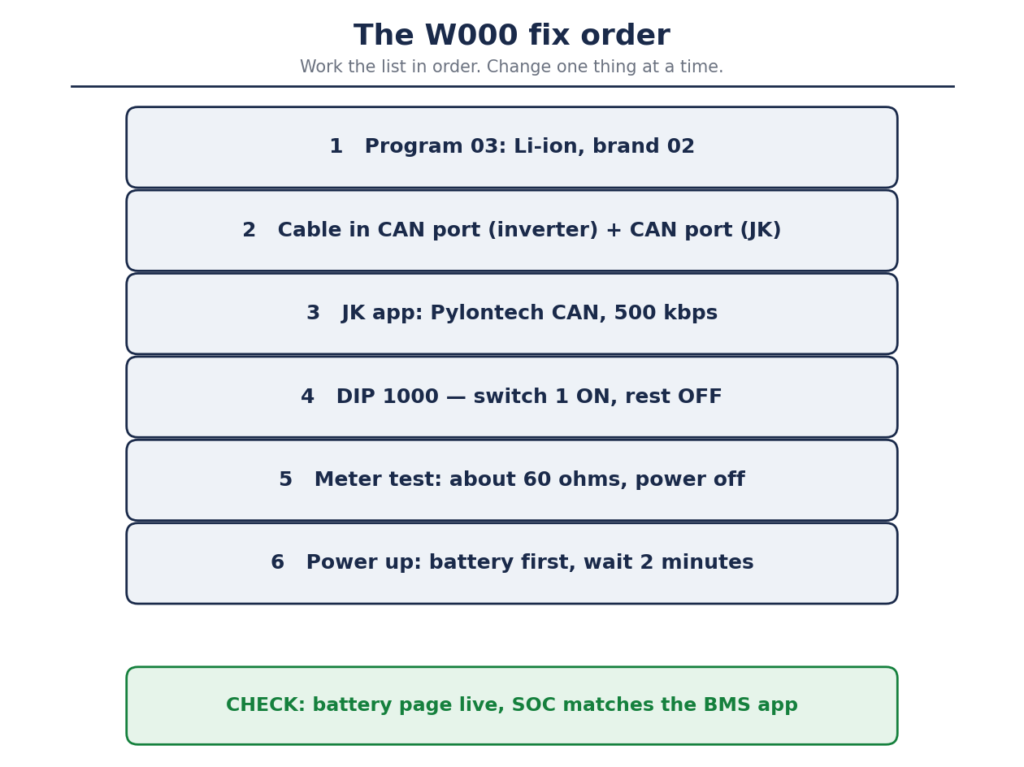
Work the steps in order. If a check fails, stop there.
- Write down what you have. Note the inverter model, battery and BMS brands, and the full code. Photograph Program 03 and the DIP switches. Check: model names and photos in hand.
- Cut the power before you touch a plug. Switch the battery breaker, DC isolator, and AC breaker off. Wait until the LCD is dark. Check: LCD dark, battery breaker off.
- Check the cable with your eyes and hands. Pull the plug at each end and look for a bent pin, a plug that does not click home, and a crushed cable. If you have a spare cable you know is good, swap it in now. Check: both plugs click home, no bent pins.
- Check the ports. On the inverter, the battery cable goes in the socket marked CAN on the BMS port. On the JK BMS, it goes in the socket marked CAN, not RS485-1. On our rig, this was the fault: the plug sat in the JK RS485 port. We moved it to the CAN port. Check: plug in the CAN port at the BMS end and the BMS port at the inverter end.
- Set Program 03 to Li-ion and brand 02. Open the LCD settings, pick Li-ion, then brand 02. If brand 02 will not link, try brand 06. On the JK app, set the CAN mode to Pylontech at 500 kbps. Set DIP to 1000: switch 1 ON, the rest OFF. Check: Program 03 still reads Li-ion and brand 02.
- Test the bus with a meter. With all power off, test ohms between CAN-H and CAN-L. A good bus reads about 60 ohms (two 120 ohm end resistors side by side). With power on and the bus idle, test each line to ground: each should sit near 2.5 V DC. On our rig, the test read 61 ohms after the plug move, and 2.5 V per line at idle. Before the move, it read open: the RS485 port has no CAN pair. Check: about 60 ohms power off, about 2.5 V per line power on.
- Power up in order and wait two minutes. Switch the battery on first, then the inverter, and wait two full minutes. A blank battery page means the link is still down. A live page with SOC and limits means the link is up. On our rig, the battery page filled in after about 40 seconds, and the screen showed 62% SOC, the same number the JK app showed. Check: battery page live, SOC matches the BMS app.
- Prove it under load. Put a load on the inverter and watch the SOC move, then charge the pack and watch it climb. On our rig, a 1,200 W kettle pulled the SOC from 62% to 61% in ten minutes. On charge, the SOC hit 100% as the pack hit 55.2 V: 16 cells times 3.45 V. Check: SOC moves with charge and discharge, and it reaches 100% without jumping.
- Write down the working settings. Note the ports, cable type, Program 03 brand, JK app mode, DIP setting, and meter readings. Tape the note inside the battery box door. Check: the note is written and the photos from Step 1 are saved.
If the reading differs, the reading is the answer
A meter can rule out a dead link in minutes. It cannot read CAN frames, but it can tell you if the bus is shorted or open. All volt numbers are DC to ground, on a CAN bus built to ISO 11898-2. On a live bus with traffic, a plain meter shows the mean: CAN-H reads 2.6 to 3.0 V and CAN-L reads 2.0 to 2.4 V. A scope shows the true peaks, 3.5 V and 1.5 V. You do not need one here.
| Reading | What it means. | What to do. |
|---|---|---|
| About 60 ohms, power off. | Both 120 ohm end resistors are there. | Go to Step 7. |
| Near 120 ohms, power off. | One end resistor is missing. | Check the BMS end resistor. |
| Open circuit, power off. | No end resistor, a broken wire, or the plug is in a port with no CAN pair. | Check the port first, then test the cable. |
| Near zero ohms, power off. | A short between CAN-H and CAN-L. | Unplug each end in turn. If the short stays with the cable, swap the cable. |
| 2.5 V on each line, power on, idle. | Bus idle and sound, but nobody is talking. | Check the brand and the BMS power. |
| 2.6–3.0 V on CAN-H, 2.0–2.4 V on CAN-L. | Traffic is flowing. The link is alive. | Go to Step 7. |
| 0 V or pack volts on one line. | That line is shorted, or the signal chip is dead. | Stop. Unplug the BMS end. If the line clears, the fault is in the BMS. |
For RS485, flipped A and B is a common fault on third-party cables. Swap A and B at one end only, then test again.

What each sign points to
| What you see. | Most likely cause. | Fix. |
|---|---|---|
| W000 on first start, blank battery page. | Plug in the wrong port, or wrong brand code. | Steps 4 and 5: match the port to the link, then set brand 02. |
| W000 clears, then comes back at noon. | Cable run tight against DC or AC wiring picks up noise at peak current. | Move the comms cable away from power cables and shorten it. |
| W000 only at night. | BMS asleep, or pack volt too low. | Charge the pack. Check the BMS sleep timer. |
| W000 plus W004. | BMS reports a fault inside the pack. | Restart the battery, then check the BMS app. |
| W000 after a firmware change. | Brand list moved or renamed. | Re-check Program 03 brand before you rewire. |
| E019 on the screen. | PV volts over 480 V, DC bus fault. | Check the PV strings, not the battery cable. |
When E019 shows up instead
If your screen shows E019, stop working on the battery cable. E019 is bus voltage high. The SNA manual says to check if the PV input is higher than 480 V. Check each solar string with no load on it. A string with too many panels in a row can push past 480 V on a cold bright morning. That is a solar wiring fault, not a battery fault. Restart the inverter once. If E019 clears and stays clear, watch it through the next cold morning. If it keeps coming back, call Luxpower or your installer. Do not change the brand or re-crimp the cable.
When volts mode is the right call
Closed-loop is better when it works, and open-loop is better than a broken closed-loop. Closed-loop means the inverter and the BMS talk to each other. Open-loop means no data cable, and the inverter charges by volts alone. If the link will not hold after a full check, or if you need the house running tonight, switch to a volts-based battery type. Volts-based SOC on LiFePO4 is rough. The discharge curve is flat in the middle, so the inverter will guess SOC wrong. Set a safe low cut-off. Use the JK app or a shunt for a true SOC number. A shunt counts amps in and out of the pack. For a 16S pack, 16 cells in a row, use bulk 55.2 V, float 53.6 V, and cut-off 48.0 V. For a 15S pack, use bulk 51.75 V, float 50.25 V, and cut-off 45.0 V. See the full volt guide in the open-loop LiFePO4 voltage settings first.
What can still go wrong
The JK pin swap.
JK’s own papers conflict on CAN-H and CAN-L pins 4 and 5. If the tests and the menu all read right and W000 still will not clear, swap CAN-H and CAN-L at one end only and test again.
The lost capacity frame.
Luxpower asks the battery for a capacity frame, CAN ID 0x379. It is not confirmed if the JK Inverter BMS sends it on its Pylontech CAN profile. If your inverter shows volts and current but no capacity, or a SOC that never moves, the lost frame is the likely cause. A bridge board that sends the missing frames is the fix then, not a new cable.
Firmware comes last, not first.
Firmware can fix a mode bug. It can also move the menu so the list shifts. Save your settings first. Use a file from Luxpower support for your exact model.
A dead BMS port.
If the tests and the menu all read right, and the BMS app shows the pack is fine, yet no traffic ever shows, the port itself may be dead. Try the RS485 link as a second test. If RS485 links and CAN does not, the CAN port or its chip is at fault. That is a support call, not a settings change. Tell support the meter readings.
Common questions
Will a reboot fix W000?
No. A reboot changes nothing about the wire, the port, or the brand. If W000 clears after a reboot and comes back the next day, the fault is still there. Work the nine steps.
Can I use a normal Ethernet cable?
Sometimes. The Pylontech box ships a normal UTP Cat5 cable. It works on some Luxpower units and fails on others. Meter it first. Build a two-wire CAN cable if it will not link.
Is W000 the same as Error 19?
No. There is no battery link fault called Error 19 on Luxpower. E019 is bus voltage high, a PV or DC bus fault. W000 is the battery link warning. Read the letter first.
My battery is not on the Luxpower list. What now?
Use brand 02 with the Pylontech CAN mode first: many packs that are not on the list still link on it. Read the JK BMS to Luxpower SNA / LXP setup first. If no brand links, run open-loop on volts.
Why does the home screen show volts but the battery page stays blank?
Volts come down the thick power cable, not the thin comms cable. A blank battery page means the data link is dead, even when the volts look fine.
Do this next
- Write down model names, and take a photo of Program 03 and the DIP switches. Cut power, then check the cable and ports.
- Set Program 03 to Li-ion and brand 02. Set the JK app to the Pylontech CAN mode at 500 kbps. Set DIP 1000.
- Test the bus: about 60 ohms power off, about 2.5 V per line at idle.
- Power up battery first, then inverter. Wait two minutes for a live battery page and a real SOC.
- Prove it under load and on charge, then write the settings on a note inside the battery box door.
- No brand links? Switch to volts mode for the night, set the volts from the datasheet, and run open-loop.
- Still stuck? Call Luxpower support with model names, settings, meter readings, and a photo of the DIP switches.
Sources
Checked on 20 November 2026. Unconfirmed items are labelled “not confirmed” in the text.
- Luxpower SNA-EU User Manual UM-SNA04001, trouble list. W000: link failure with battery, check brand and cable. W004: battery failure, restart the battery. E019: bus voltage high.
- Luxpower SNA PRO-EU User Manual UM-SNA06001E01, error list. W000, W003 meter link failure, W004 battery failure.
- Luxpower SNA5000 User Manual, LCD settings. Program 03: Li-ion, then brand. Brand list: 0 plain, 2 Pylon, 6 Luxpower mode, 8 Dyness. Pin list: pin 1 RS485B, pin 2 RS485A, pin 4 CAN-H, pin 5 CAN-L.
- Luxpower SNA5000 training manual. CAN pins 4 and 5 on the inverter and on Pylon, Dyness, and Shoto packs.
- Hubble Luxpower setup guide. Older SNA units put CAN-L on pin 3, not pin 5.
- ISO 11898-2 CAN standard. Idle 2.5 V per line. Peaks 3.5 V / 1.5 V. 120 ohm per end, about 60 ohms measured.
- JK BMS community reports. JK Inverter BMS, Pylontech CAN, 500 kbps, works on brand 02. Field-reported. JK papers conflict on CAN-H/L pins 4/5; not confirmed.
- Luxpower 0x379 capacity frame: not confirmed if the JK BMS sends it on Pylontech CAN.
- This site: Luxpower SNA / LXP BMS port pinout, JK BMS to Luxpower SNA / LXP setup, Growatt Error 20 fix, open-loop LiFePO4 voltage settings.
Comments (0)