
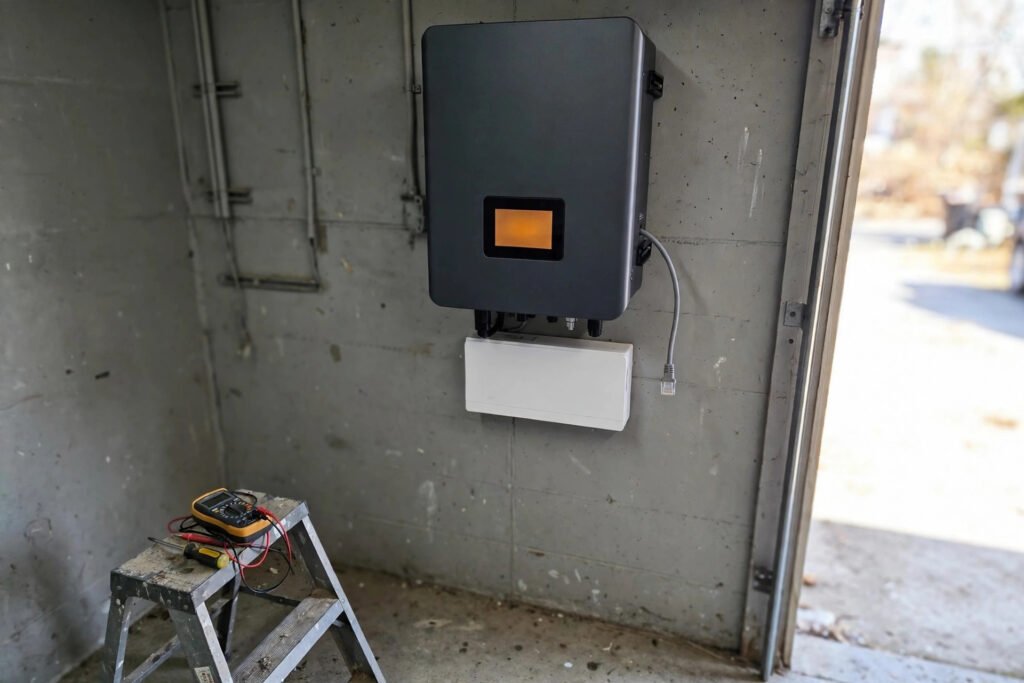
What this guide works from. One rig: a Deye SUN-8K-SG01LP1 hybrid inverter. A JK Inverter BMS on a 16-cell LiFePO4 pack, 280 Ah. The pack rested at 52.8 V. The JK app showed 58% charge. The screen showed F58. The inverter had stopped.
The short answer. F58 means the inverter has lost the talk with the battery BMS. BMS means battery management system. It is the small board that guards the cells. The battery is not dead, and the inverter is not broken. The link between them is down. On our rig, the fix was a plug in the wrong port. The cable sat in the JK BMS RS485 port while the inverter waited for CAN on Lithium Mode 00. We moved one plug to the CAN port. F58 cleared within five minutes. The inverter checks again every five minutes, and starts up on its own if the link is back.
The rig that stopped at noon
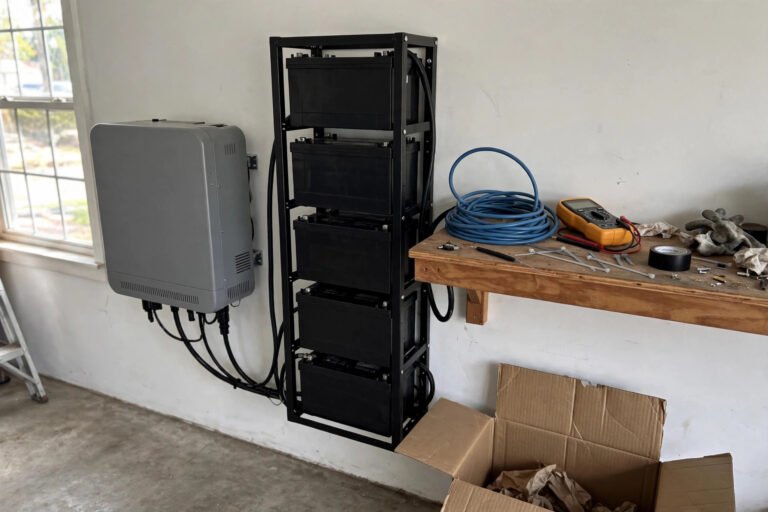
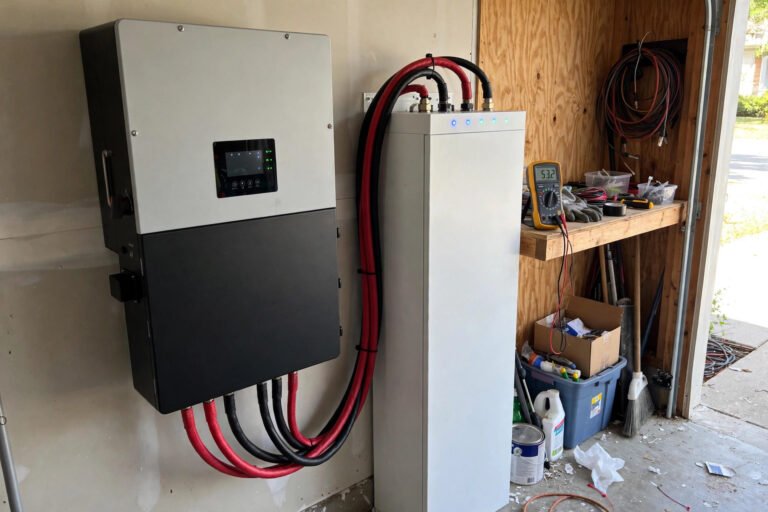
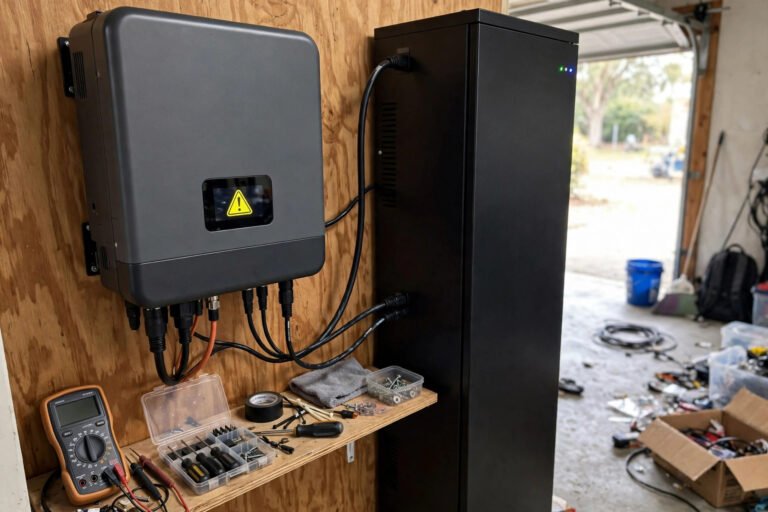
It was a new build, and it had run well for two months. The SUN-8K sat on the wall, and the battery box held 16 LiFePO4 cells. A JK Inverter BMS sat on top of the pack. The pack read 52.8 V: 3.30 V per cell, times 16 cells. The JK app showed all 16 cells between 3.29 V and 3.31 V, and 58% charge. State of charge, or SOC, is how full the battery is. Then, at noon, the screen showed F58. The inverter stopped. The pack still read 52.8 V. The JK app still showed 58%. The inverter had volts, but it had no data: no SOC, no charge limit, no cell temps. Without data, the inverter will not trust the battery.
What F58 means, exactly
F58 tells you that talk between the hybrid inverter and the battery BMS is cut off when BMS_Err-Stop is on. F58 is not a battery fault. It is a link fault. It only stops the inverter because BMS_Err-Stop is turned on. The manual’s own fix is printed in the fault list: turn off BMS_Err-Stop on the LCD. That clears the code, but it does not fix the link.
The same code shows up on Sunsynk inverters, which share the Deye base and fault numbers. It means a loose or wrong-port comms lead, a battery off or asleep, or a battery not on the approved list for your firmware. This covers the single-phase SUN-5K, SUN-8K and SUN-12K SG01 and SG04LP1 series, and the three-phase SUN-5K to 12K SG04LP3 series.
One note: this guide is for Deye hybrid inverters, the ones with a battery. On Deye string inverters, the grid-tie units with no battery, F58 can mean a grid over-current fault. Check your model first. If your inverter has no battery port, do not use the steps below.
Before you touch anything, write down the exact code, the LCD volts, and the battery type.
The 10-second rule and the 5-minute retry
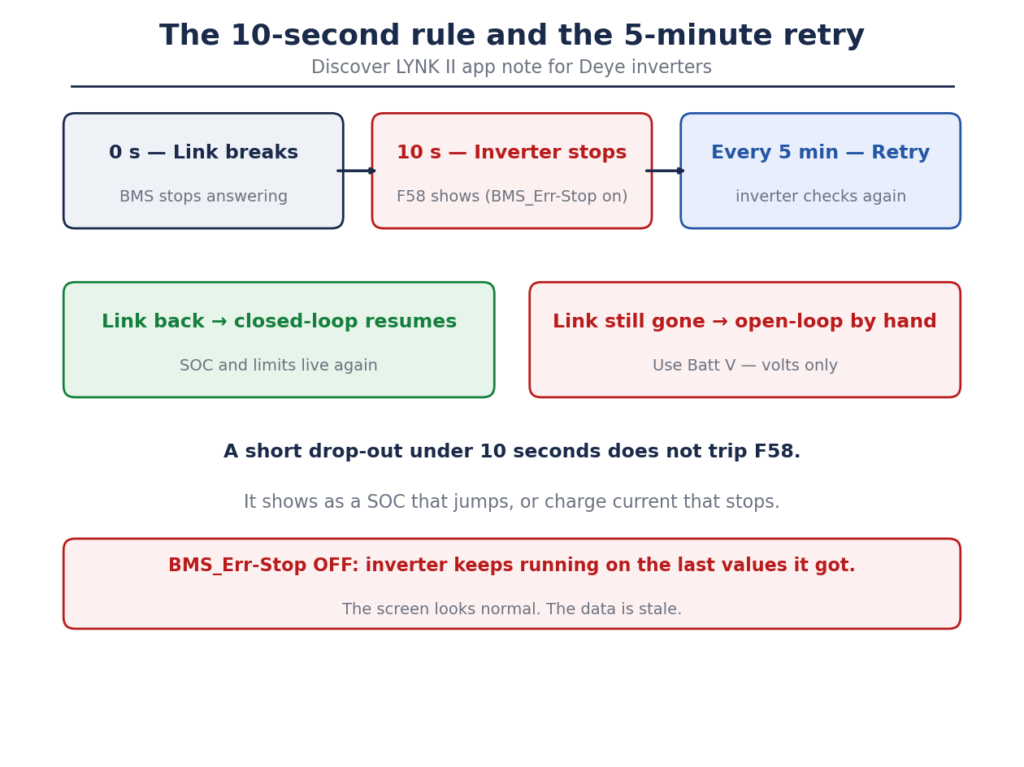
The Discover LYNK II app note puts numbers on it. If the break in talk lasts more than ten seconds, the inverter stops. That holds as long as BMS Lithium Batt and BMS_Err_Stop are both on. It shows F58. Then it checks every five minutes. If talk comes back, it starts closed-loop work again. If talk cannot come back, change the inverter to open-loop by hand. Open-loop means the inverter charges by volts only, with no BMS data.
A short drop-out does not trip F58. Ten seconds of quiet is the line. A cable that drops for a second under load will not show F58. But it will show as a SOC that jumps. Or a charge current that stops for no clear cause. F58 is not a latch you must clear by hand. Fix the cable while the inverter still shows F58. It will find the BMS again within five minutes and start up. If it does not start up after five minutes, the fix did not take. Or the fault is someplace else in the chain.
What the pins carry
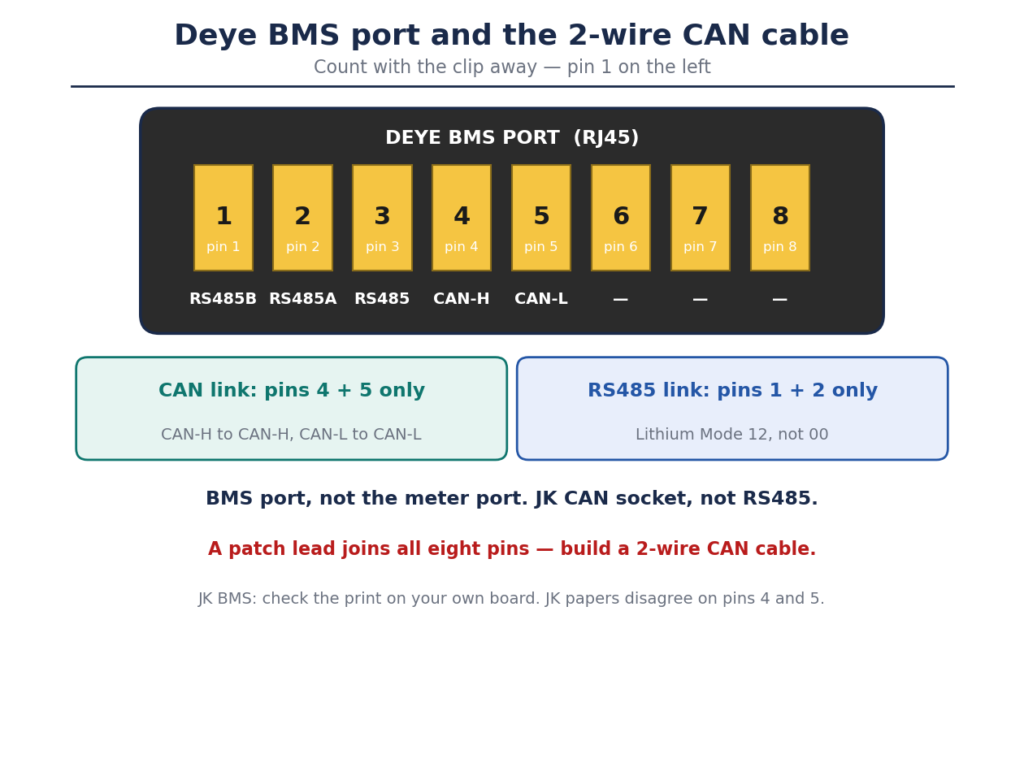
The Deye BMS port puts CAN-H on pin 4 and CAN-L on pin 5, with RS485 on pins 1 to 3 on the newer 2-in-1 port. Count pins with the clip facing away from you, pin 1 on the left. The full guide is the Deye and Sunsynk BMS port pinout. For a CAN link, only pins 4 and 5 matter. For an RS485 link, only pins 1 and 2 matter. Do not wire both links at once. One warning about the JK side: JK’s own papers disagree on which pin is CAN-H and which is CAN-L on some boards. Read the print on your own board and wire H to H and L to L from that print. Step 9 will catch a swap.
| Pin | Wire | What it does. |
|---|---|---|
| 1 | RS485B | RS485 data, B side. |
| 2 | RS485A | RS485 data, A side. |
| 3 | RS485 | RS485 on the 2-in-1 port. |
| 4 | CAN-H | CAN data, high line. |
| 5 | CAN-L | CAN data, low line. |
| 6 | Not used | No battery wire here. |
| 7 | Not used | No battery wire here. |
| 8 | Not used | No battery wire here. |
The other port trap is on the battery: the JK BMS has a CAN socket and an RS485 socket. The cable goes in the socket that matches the link you chose. On our rig, the cable was in the right socket on the inverter and the wrong socket on the BMS.
Which setting fits your battery
On the Deye touch screen, go to Battery Setting. Set Battery Type to Lithium, and set Lithium Mode to 00, the Pylontech CAN code from the Deye approved battery list. For Pylontech on RS485, the code is 12, and that is a different link with different pins. The approved list has version numbers. DY-LV48-0128, dated 4 September 2026, lists Pylontech US2000B, US3000, US2000C, US3000C, UP5000, US5000, Force L1 and Force L2 on CAN with Lithium Mode 00. If your battery is not on the list for your firmware, the inverter may refuse the link. Our rig is row three: JK Inverter BMS, CAN, Lithium Mode 00, DIP 1000.
| Battery and inverter | Link and port | Battery Type | Lithium Mode |
|---|---|---|---|
| Pylontech US5000 with SUN-8K | CAN, battery CAN port to BMS port. | Lithium | 00 |
| Pylontech US2000 / US3000 with SUN-8K | RS485, battery RS485 port to BMS port. | Lithium | 12 |
| JK Inverter BMS with SUN-8K | CAN, BMS CAN port to BMS port. | Lithium | 00 |
| JK Inverter BMS with SUN-8K, CAN will not link | RS485, BMS RS485 port to BMS port. | Lithium | 12 |
For the JK app, use CAN protocol Pylontech at 500 kbps for a CAN build. Use RS485 protocol Pylontech for an RS485 build. Picking a Pylontech RS485 profile does nothing for a CAN cable. On a Pylontech battery there is nothing to pick in an app. Pylontech CAN runs at 500 kbps. Some JK PB manuals list a default CAN speed of 250 kbps, but the speed is a setting, not a fixed fact of the board. If your JK app shows a CAN baud setting, set it to 500 kbps.
Why the inverter cannot hear the battery
F58 is a handshake fault. A handshake is the short exchange where two units agree they can talk. The inverter sends a frame on the CAN bus: one short packet of data. The BMS must answer with its own frame: SOC, charge limit, cell volts, temps, alarms. If no answer comes back in ten seconds, the inverter stops and shows F58. That talk can fail in only four ways: the wire is wrong, the port is wrong, the protocol is wrong, or the bus is broken. A reboot fixes none of these.
A plain Ethernet patch lead is the most common wire fault. It joins all eight pins. That can join CAN to RS485 at the same time on the 2-in-1 BMS port. A true CAN cable carries CAN-H and CAN-L on one twisted pair. On our rig, the patch lead was fine. It was just plugged into the wrong socket. Lithium Mode 00 on an RS485 wire hears nothing, because the inverter listens on pins 4 and 5. Check the wire and the port first, then check the menu.
Fix it in order: nine steps, each with a check
Work the steps in order. If a check fails, stop there. Do not change three things at once.
- Write down what you have. Note the inverter model, the battery brand, the exact code, and the LCD volts. Photograph the Battery Setting menu. Check: model names, code, volts, and photos in hand.
- Check the battery is on. Check the battery’s own lights first. A battery that has gone to sleep after a deep drain will not talk. Close the battery DC breaker, switch the BMS on, and watch the RUN light. Check: RUN light on, battery awake.
- Check the cable is in the BMS port at both ends. On the Deye, the port is marked BMS. On the battery, it is the CAN port, not the RS485 port and not the parallel link port. Reseat the plug at both ends. Power all down first, then reseat. On our rig, this was the fault: the plug sat in the JK RS485 port while the inverter waited for CAN. Check: plug in the CAN port at the BMS end and the BMS port at the inverter end.
- Set Battery Type and Lithium Mode. Go to Battery Setting. Set Battery Type to Lithium, and set Lithium Mode to 00 for a CAN build, or 12 for RS485. Check: Battery Type reads Lithium, Lithium Mode reads 00.
- Check the DIP switches. On a JK Inverter BMS, DIP 1000 sets the pack as address 0, the master, for a single pack. That means switch 1 ON, switches 2, 3 and 4 OFF. In a bank of packs only one pack is the master that talks to the inverter, so do not set two packs to 1000. Check: one master only, DIP 1000 on the master pack.
- Check the protocol and the speed. In the JK app, use CAN protocol Pylontech at 500 kbps for a CAN build. Use RS485 protocol Pylontech for an RS485 build. Restart the BMS after a protocol change. Check: JK app shows Pylontech CAN at 500 kbps.
- Test the bus with a meter. Power both units off, unplug the CAN cable from one end, and measure CAN-H to CAN-L. About 60 ohm means both ends are closed off right. Near 120 ohm means one end is missing. Open circuit means a broken wire or no end resistor. With power on and the bus idle, test each line to ground. Each should sit near 2.5 V DC. On our rig, the power-off test read 61 ohms after the plug move. The idle test read 2.5 V on each line. Check: about 60 ohms power off, about 2.5 V per line power on.
- Power-cycle in order, then wait. Power-cycle the BMS, then the inverter, and wait two minutes. Then wait up to five minutes more for the inverter’s retry. If F58 is still there after that, the fault is not a loose plug. On our rig, the Li-BMS page showed 58% SOC about three minutes after the plug move. Check: SOC matches the BMS app after five minutes.
- Swap CAN-H and CAN-L at one end only, and only if your board drawing shows the flipped pin order. Some JK PB board drawings show CAN-L on local pin 4 and CAN-H on local pin 5. Never swap both ends. Check: link up after the swap, or back to the first order if it did not help.

If the reading differs, the reading is the answer
A meter can rule out a dead link in minutes. It can tell you if the bus is shorted or open. All volt numbers are DC to ground, on a high-speed CAN bus built to ISO 11898-2. On a live bus with traffic, a plain meter shows the average: CAN-H reads 2.6 to 3.0 V and CAN-L reads 2.0 to 2.4 V. An oscilloscope shows the true peaks, but you do not need one here.
| Reading | What it means. | What to do. |
|---|---|---|
| About 60 ohms, power off. | Both 120 ohm end resistors are there. | Go to Step 8. |
| Near 120 ohms, power off. | One end resistor is missing. | Check the BMS end resistor. |
| Open circuit, power off. | No termination, broken wire, or plug in a port with no CAN pair. | Check the port first, then the cable. |
| Near zero ohms, power off. | A short between CAN-H and CAN-L. | Unplug each end in turn. If the short stays with the cable, replace it. |
| 2.5 V on each line, power on, idle. | Bus idle and healthy, but nobody is talking. | Check the protocol and the BMS power. |
| 2.6–3.0 V on CAN-H, 2.0–2.4 V on CAN-L. | Traffic is flowing. The link is alive. | Go to Step 8. |
| 0 V or pack volts on one line. | That line is shorted, or the signal chip is dead. | Stop. Unplug the BMS end. If the line clears, the fault is in the BMS. |
For RS485, the same idea holds with different pins. Flipped A and B is a common fault on third-party cables. If RS485 will not link, swap A and B at one end only, then test again.
What each symptom points to
| What you see. | Most likely cause. | Fix. |
|---|---|---|
| F58 on boot, no SOC. | Plug in the wrong port, or wrong Lithium Mode. | Steps 3 and 4: match the port to the link, then set 00. |
| F58 clears, then comes back at noon. | Cable tight against DC or AC wiring picks up noise at peak current. | Move the cable away from power cables and shorten it. |
| F58 only at night. | BMS asleep, or pack volt too low. | Charge the pack. Check the BMS sleep timer. |
| F58 plus a flat pack. | BMS cut discharge to guard the cells. | Charge first if you can, then fix the link. |
| W31 warning, inverter still running. | Link weak, or BMS data odd. | Reseat both ends, check the cable route. |
| F56, battery missing or not charging. | Battery itself not seen. | Breaker, fuse, battery on first, then comms. |
F58 is not W31, and it is not F56
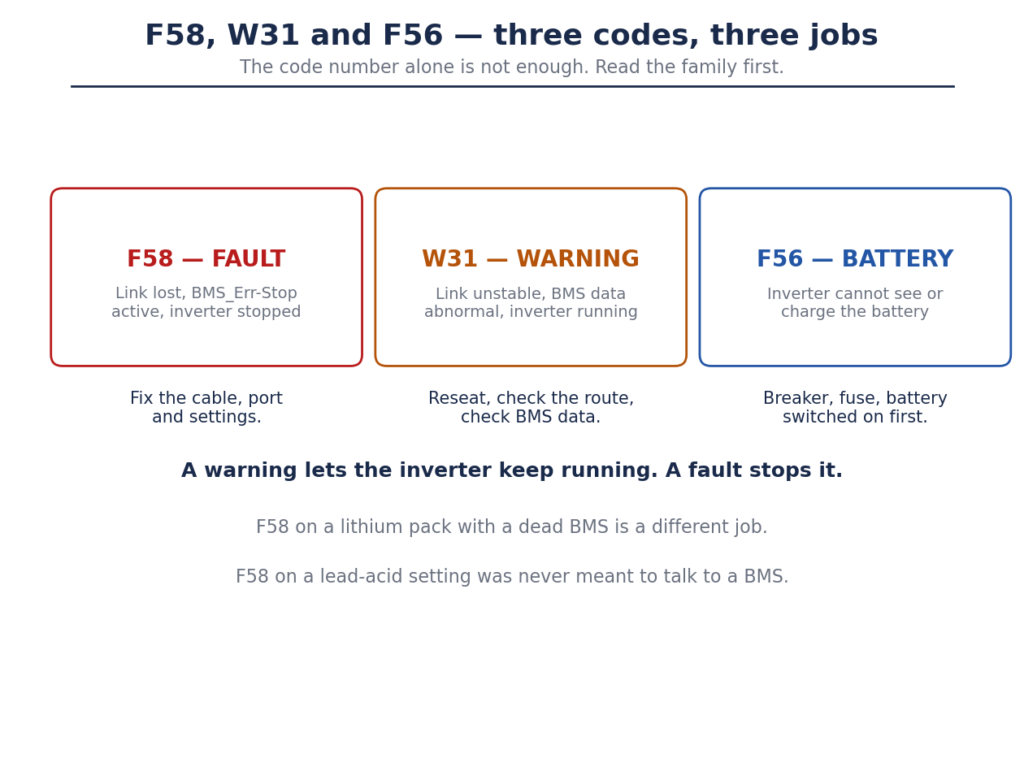
F58 is the fault: the inverter stops. W31 is the warning form, Battery_comm_warn: check if the BMS link is firm, and check if the BMS data looks wrong. A warning lets the inverter keep running, while a fault stops it. W31 means the link is weak but alive. F58 means the link is gone.
F56 is the next-door battery code for a battery the inverter cannot see or charge. F58 is the cable, the port and the settings. F56 needs the battery itself checked first: breaker, fuse, battery switched on. Check those before you touch the comms cable.
When F58 shows up after a deep drain
If F58 shows up after a deep drain, the battery most likely went to sleep. The BMS cuts discharge to guard the cells. A sleeping BMS does not answer CAN frames. Charge the pack from grid or solar, on volts if you have to. The BMS will wake. Do not clear the fault by turning BMS_Err-Stop off and leaving it off. That hides the fault. It lets the inverter run with no BMS data, which is open-loop with no warning. With no live BMS data, the inverter can overcharge the battery or drain it flat. Do not run like that for days.
When Use Batt V is the right call
If the protocol will not link after a full check, switch the Deye to Battery Type Use Batt V. Do the same if you need the house running tonight. Set the charge volts from the battery datasheet, and the inverter will charge by volts while the BMS guards the pack. Volts-based SOC on LiFePO4 is rough. The flat curve makes the inverter guess wrong. Use the BMS app or a shunt for a true SOC number. For a 16S pack: 55.2 V bulk, 53.6 V float, 48.0 V cut-off. For a 15S pack: 51.75 V bulk, 50.25 V float, 45.0 V cut-off. See the full volt guide in the closed-loop vs open-loop LiFePO4 settings before you set the volts.
What can still go wrong
The JK pin swap.
JK’s own papers conflict on CAN-H and CAN-L pins 4 and 5. If the 60 ohm test, the volts, and the menu all read right, and F58 still will not clear, swap CAN-H and CAN-L at one end only.
Firmware comes last, not first.
Firmware can fix a protocol bug, but it can also move the menu so the list shifts. Check Lithium Mode 00 again after any update. Save your settings first.
The cable that worked yesterday.
A comms cable run tight against DC lugs or AC wiring can pick up noise when current peaks. If F58 comes back under load, move the cable and shorten it.
A dead BMS port.
If the 60 ohm test, the volts, and the menu all read right, and the BMS app shows the pack is fine, yet no traffic ever shows, the port itself may be dead. Try the RS485 link as a second test. If RS485 links and CAN does not, the CAN port or its chip is at fault. That is a support call. Tell support the meter readings.
Common questions
Does F58 mean my battery is dead?
No. F58 means the link is down, not the cells. If the BMS app still shows cell volts and SOC, the battery is alive.
Will a reboot fix F58?
No. A reboot changes nothing about the wire, the port, or the protocol. If F58 clears after a reboot and comes back, the fault is still there. Work the nine steps.
What does BMS_Err-Stop do?
With it on, a lost link stops the inverter and shows F58. With it off, the inverter keeps running on the last values it got. Use it as a test, not a fix.
Is F58 the same on Sunsynk?
Yes. Sunsynk shares the Deye base and the fault numbers. The same checks apply.
My battery is not on the Deye list. What now?
Use Batt V and run open-loop. Set the volts from the datasheet: for a 16S pack, 55.2 V bulk, 53.6 V float, and 48.0 V cut-off. Many packs that are not on the list still link on Lithium Mode 00 with the Pylontech profile.
Do this next
- Write down the code and the LCD volts. Check the battery is on and its RUN light is live.
- Reseat the cable in the BMS port at both ends. Set Battery Type Lithium and Lithium Mode 00.
- Check the DIP switches and the protocol on the BMS. Set the JK CAN speed to 500 kbps.
- Run the powered-off 60 ohm test between pins 4 and 5. Power-cycle the BMS, then the inverter, and wait five minutes.
- If F58 clears, watch it for a full charge cycle before you call it fixed.
- If it does not clear, switch to Use Batt V for the night, and work the list again in daylight.
- If the fault stays, call your dealer with the inverter serial number, the date it first showed, and what you already tried.
Sources
Checked on 20 November 2026. Unconfirmed items are labelled “not confirmed” in the text.
- Deye SUN-8K-SG01LP1 user manual, fault list. F58 shows when BMS_Err-Stop is on and comms fail. F13 shows when battery mode changed to No Battery mode. W31 is Battery_comm_warn.
- Deye approved battery list DY-LV48-0128, dated 4 September 2026. Pylontech US2000B, US3000, US2000C, US3000C, UP5000, US5000, Force L1 and Force L2 on CAN, Lithium Mode 00.
- Discover LYNK II app note for Deye inverters. A link break over ten seconds stops the inverter. The inverter retries every five minutes.
- Sunsynk fault guides. F58 means a loose or wrong-port comms lead, a battery off or asleep, or a battery not on the approved list. F56 is the battery missing code.
- JK BMS community reports. JK Inverter BMS, Pylontech CAN, 500 kbps, works on Lithium Mode 00. DIP 1000 sets pack address 0, the master. JK papers conflict on CAN-H/L pins 4/5; not confirmed.
- ISO 11898-2 CAN standard. Idle 2.5 V per line. Dominant 3.5 V / 1.5 V. 120 ohm per end, about 60 ohms measured.
- Discover guide on open-loop risk. With no live BMS data, the inverter can overcharge the battery or drain it flat.
- This site: JK BMS to Deye setup, Deye & Sunsynk BMS port pinout, closed-loop vs open-loop LiFePO4 settings, Deye No Battery after firmware update.
Comments (0)